
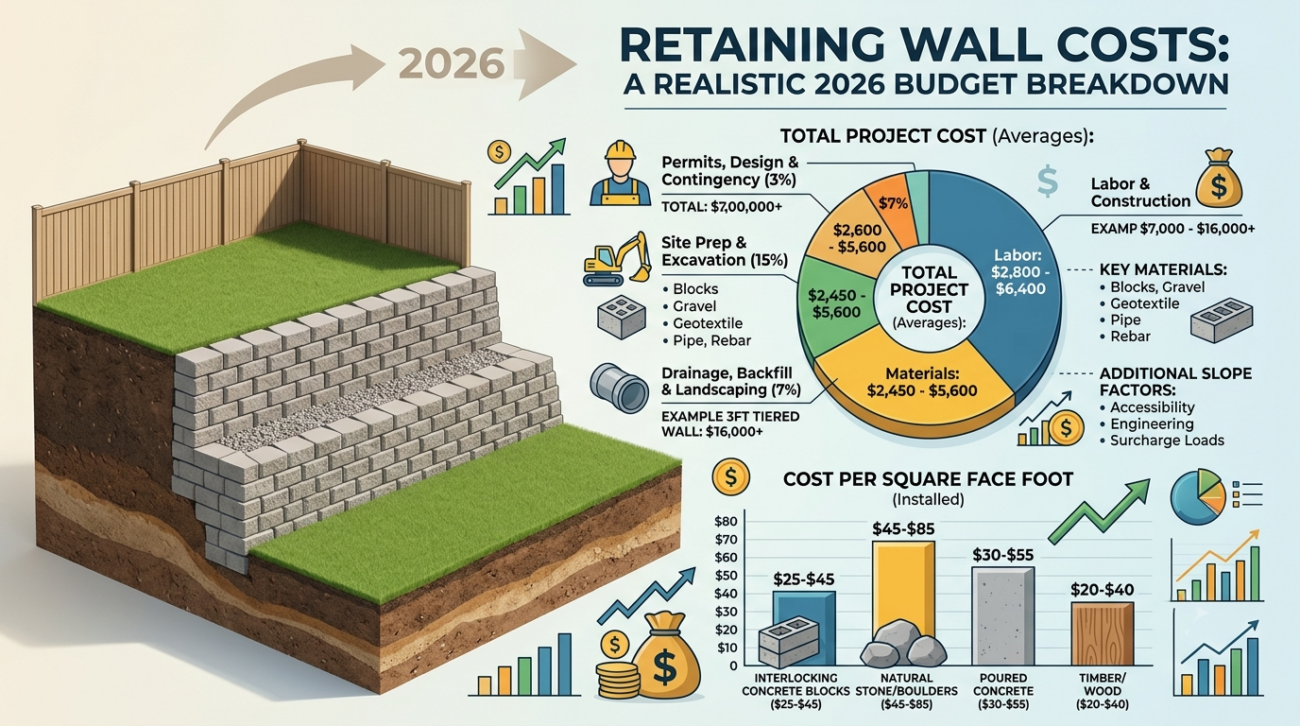
A sloped backyard is the kind of problem that looks purely cosmetic until you realize it’s actually an erosion, drainage, and usable-space problem wearing a landscaping costume. Soil washes away during every heavy rain. The flat, usable portion of your yard keeps shrinking. And the patio or garden bed you’ve been dreaming about simply can’t exist on a 20-degree grade.
A retaining wall solves all of it, but the price range you’ll find quoted online is genuinely enormous, and for good reason. This breaks down exactly what drives the cost up or down, material by material, so you can budget accurately before calling a contractor.
The Honest Price Range (And Why It’s So Wide)
Multiple 2026 industry sources converge on a similar range: expect to pay roughly $30 to $150 per linear foot for a wall between 2 and 6 feet tall, according to Angi’s 2026 cost data, with most homeowners landing on a total project cost between $3,194 and $9,195 and a national average around $6,069.
A separate breakdown from BuiltRight Academy puts it in square-foot terms: $20 to $60 per square foot of wall face installed, noting that a typical 50-foot-long, 3-foot-tall residential wall runs $4,000 to $12,000 in concrete block, or $6,000 to $18,000 in natural stone.
Cost by Material
| Material | Cost Per Square Foot | Best For |
| Pressure-treated timber | $15 – $25 | Budget walls under 3 ft, temporary terracing |
| Segmental concrete block | $20 – $40 | Most residential walls the, DIY-friendly standard |
| Poured concrete | $25 – $50 | Tall, structural, load-bearing walls |
| Natural stone | $15 – $95 | High-end aesthetic walls, varies hugely by stone type |
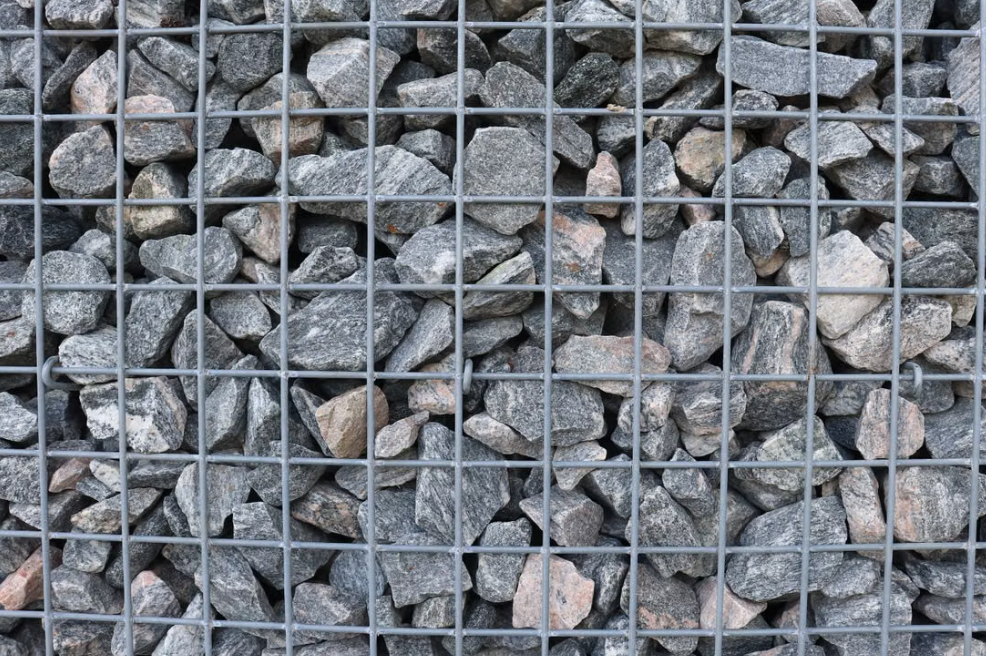
| Gabion (wire cages filled with rock) | $10 – $55 | Steep slopes, erosion control, low-maintenance |
Gabion walls deserve a specific mention: they don’t require a poured concrete foundation, which keeps installation simpler and cheaper, but the trade-off is a more industrial, less polished look. They’re common on lakeshores and steep highway slopes for exactly that reason.
The Factor That Changes Everything: Wall Height
Cost doesn’t scale evenly with height; it scales steeply because the engineering requirements jump at certain thresholds.
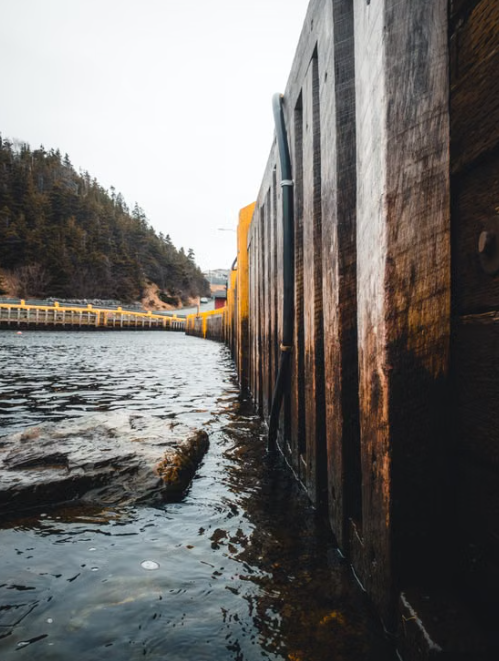
A guide from BuiltRight Academy frames this distinction clearly: a 2-foot wall is a straightforward DIY project, while a 4-foot wall is a serious construction project requiring an engineer, permits, and a contractor experienced specifically with structural retaining walls.
| Wall Height | Complexity Level | Engineer/Permit Needed? |
| Under 2 feet | Beginner DIY | Rarely required |
| 2 – 3 feet | Intermediate DIY or pro | Sometimes, check local code |
| 3 – 4 feet | Professional recommended | Usually required |
| Over 4 feet | Professional required | Always required |
Drainage: The Step That Determines Whether Your Wall Survives
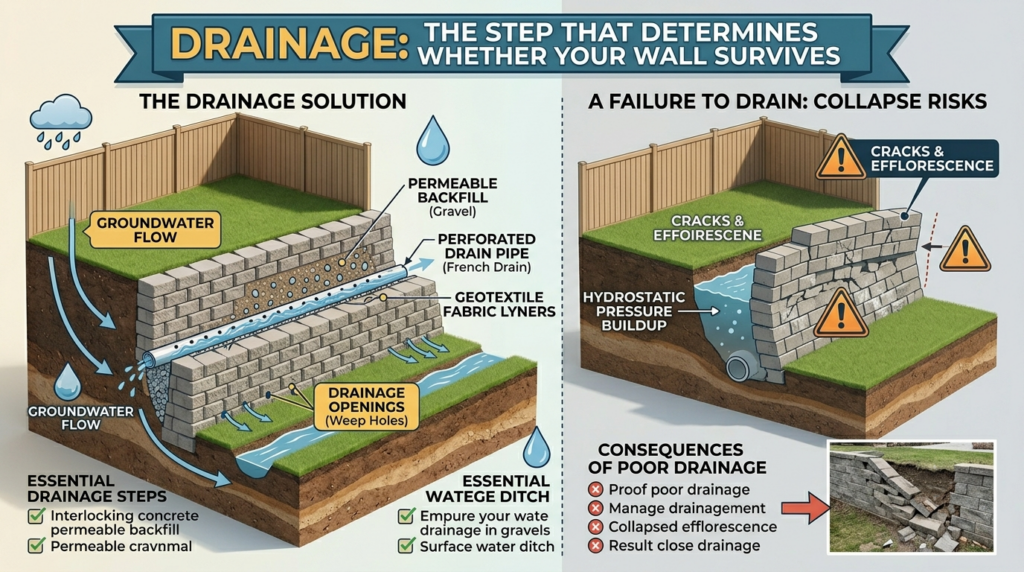
This is, without exaggeration, the most important technical detail in this entire project, and it’s the one most commonly skipped by inexperienced DIYers.
Every retaining wall needs a drainage system behind it to relieve hydrostatic pressure the force of water building up in the soil behind the wall- which causes bowing, cracking, and eventual collapse if it isn’t managed.
A detailed 2026 cost calculator breakdown from Constructlytools states it directly: a 2-foot wall that fails almost always fails because drainage was skipped.
The fix is genuinely inexpensive relative to the cost of a failed wall drainage materials (gravel, perforated pipe, filter fabric) typically run $70 to $115 for a modest residential wall, an investment that’s trivial compared to redoing an entire collapsed structure.
If you’re hiring out drainage as a standalone fix or pairing it with the wall project, a French drain installed behind a retaining wall runs $10 to $85+ per linear foot, depending on complexity, per HomeGuide’s 2026 retaining wall cost guide.
Can You DIY a Retaining Wall?
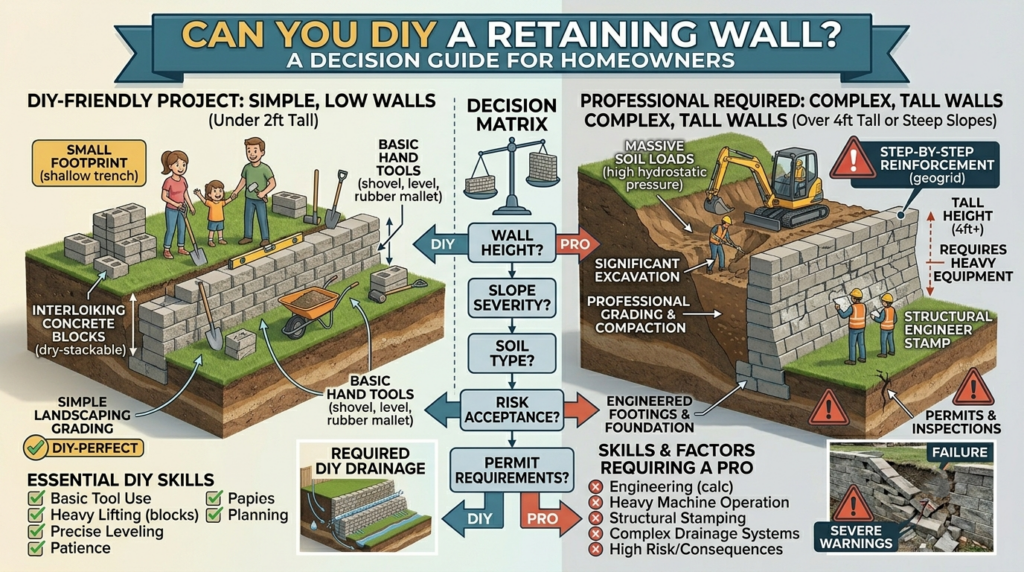
Yes, within real limits. The consistent guidance across contractor sources draws the same line:
- DIY-appropriate: Walls under 3 feet using segmental concrete block on flat-to-moderate sites. DIY can realistically save 40% to 60% on labor costs for projects in this category.
- Hire a pro: Walls over 3 feet, poor site access, clay or consistently wet soil, sloped foundation areas, or any wall that requires a permit in your jurisdiction.
- Always hire a pro: Walls over 4 feet, any wall built near a structure (house, garage, driveway), or walls that will support a surcharge load like a driveway, pool, or additional slope above them.
If you do go the DIY route on a smaller wall, the single technical detail to get right above all others is the base course: it needs to be buried one full course below finished grade and perfectly level along its entire length, since every course built above it compounds any error in that first layer.
Building on a Slope vs. Flat Ground
Sloped sites specifically add cost beyond what flat-ground estimates account for. HomeGuide’s 2026 data notes that sloped yards need more extensive excavation and may require terracing, building multiple shorter walls in steps rather than one tall wall, which can increase total project cost by 50% or more compared to an equivalent wall on level ground.
Terracing isn’t just a cost driver, though it’s often the better design choice on a meaningfully sloped lot.
Multiple 2-foot walls stepping down a hillside are individually simpler, cheaper per wall, and frequently don’t trigger the same permit requirements as one continuous 6-foot wall, while creating more usable flat space across the property overall.
Rebuilding an Old, Failing Wall
If you’re replacing an existing wall rather than building on virgin ground, factor in demolition costs of $15 to $30 per linear foot plus disposal fees for the old materials. The upside of a rebuild: it’s an opportunity to finally install proper drainage if that’s what caused the original failure, and some contractors offer a discount when demolition and new construction are bundled into a single project.
Smart Ways to Control Cost Without Cutting Corners
- Choose segmental block over natural stone unless the aesthetic is a non-negotiable priority, the performance difference is minimal, but the cost difference is significant
- Get multiple quotes that explicitly itemize drainage; some contractors quote a stripped-down price and treat proper drainage as an upsell
- Consider terracing with shorter walls instead of one tall wall on steep slopes, frequently cheaper in aggregate and easier to permit
- If your wall is under the height threshold for DIY, doing it yourself can realistically cut total cost by close to half, provided you take the base course and drainage steps seriously
Bottom Line
A realistic budget for a typical residential retaining wall lands between $3,000 and $12,000, depending on height, material, and site conditions, with sloped lots and taller walls pushing toward the higher end. The single decision that matters most isn’t material choice; it’s drainage.
Skip proper drainage to save a few hundred dollars, and there’s a real chance you’ll be paying for the entire wall again within a few years.
