
Every summer, the same confusion resurfaces in home improvement forums and contractor consultations: someone wants to cool their house without running the air conditioner around the clock, and they keep seeing two products that sound nearly identical. A whole house fan and an attic fan are not the same thing; they don’t do the same job, and choosing the wrong one means spending several hundred dollars on a system that barely moves the needle on comfort.
Here’s the honest breakdown of what each one actually does, what it costs, and which homes genuinely benefit from each.
The Core Difference
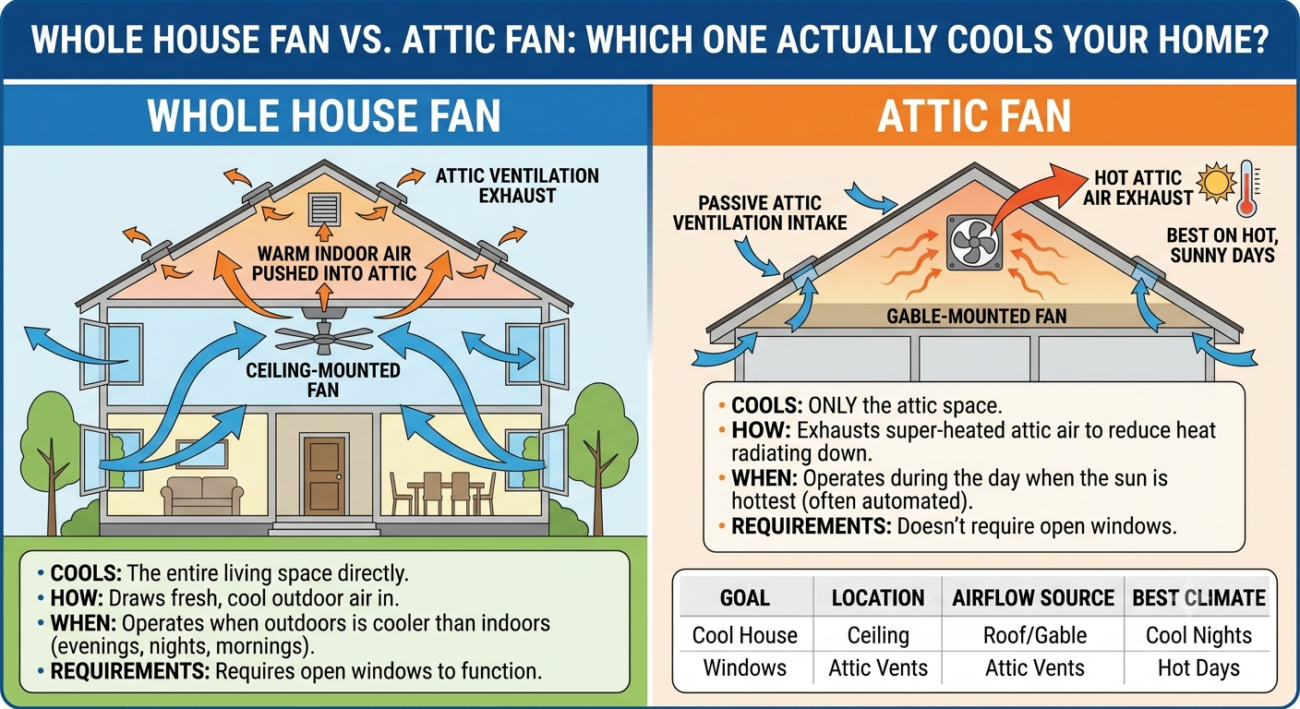
A whole house fan is mounted in your ceiling, between the living space and the attic.

It actively cools your entire home by pulling cool outdoor air in through open windows and pushing warm indoor air up and out through attic vents, replacing all the air in your home roughly every 1 to 3 minutes, according to a 2025 comparison from Greenwashing Index.
An attic fan (sometimes called a powered attic ventilator) lives entirely inside the attic and only cools that space. It exhausts hot, trapped attic air through roof or gable vents, which reduces heat radiating down into your living areas, but it does not actively cool the rooms you’re sitting in.
Cost Comparison
| System | Typical Installed Cost | What It Cools |
| Attic fan | $250 – $900 | Attic space only |
| Whole house fan | $800 – $3,600 | Entire living space |
According to HomeAdvisor’s 2025 cost data, whole house fans average around $1,700 installed, with basic models running as low as $800 and high-end variable-speed smart systems reaching $3,600.
Attic fans are considerably cheaper to install; Angi reports a typical range of $400 to $900 for professional installation, dropping as low as $250 to $350 for the most basic gable-mounted units, according to a separate breakdown from Aire Serv.
How Each One Actually Performs
Whole House Fans: Dramatic, Climate-Dependent Cooling
Because a whole house fan exchanges essentially all the air in your home within a few minutes, the cooling effect is immediate and noticeable the moment you turn it on, provided outdoor conditions cooperate.
This is the catch: whole-house fans only work well when nighttime or early-morning outdoor temperatures are meaningfully cooler than indoor temperatures.
In climates with hot, humid nights, or regions where outdoor temperatures barely drop after sunset, the fan has nothing cool to pull in, and its effectiveness collapses.
One homeowner account cited in industry coverage described a whole house fan paying for itself within just two cooling seasons through reduced air conditioning use, a realistic outcome specifically in dry, temperate climates with a wide day-to-night temperature swing, like much of the inland West and parts of the Mountain states.
Attic Fans: Modest, Reliable, Climate-Independent
Attic fans don’t promise dramatic comfort improvements in your living space, but they deliver a more predictable, smaller benefit almost everywhere: by keeping the attic closer to outdoor ambient temperature, they reduce the amount of heat radiating down through your ceiling insulation. According to Aboutdarwin’s 2025 comparison, typical attic fans move between 1,000 and 1,600 CFM and operate during the hottest daytime hours when solar radiation heats the attic to extreme temperatures, often 130°F or higher in summer.
Because they work independently of your home’s cooling system and don’t require open windows, attic fans function in virtually any climate, including humid regions where a whole house fan would be ineffective most of the year.

Energy and Bill Impact
Both systems use dramatically less electricity than central air conditioning. Per Fixr’s cost analysis, running a central air conditioner in an energy-efficient home can cost around $115 per month at current electricity rates, while either fan type draws a small fraction of that load.
The Greenwashing Index comparison notes that whole house fans specifically can reduce cooling bills by up to 50% in climates where they’re well-suited, while attic fans deliver smaller but still meaningful reductions almost everywhere by easing the air conditioner’s workload.
Which One Should You Choose?
Choose a whole house fan if:
- You live somewhere with cool, dry nights and meaningfully lower nighttime temperatures (much of the Mountain West, parts of the Pacific Northwest, high-desert climates)
- You’re comfortable opening windows at night and in the early morning to let the fan do its job
- Your goal is active comfort in living spaces, not just reduced attic heat
- You want a bigger dent in your air conditioning bill and have the climate to support it
Choose an attic fan if:
- You live in a humid climate where nighttime temperatures don’t drop enough for a whole house fan to be effective
- You want a lower-cost, lower-effort upgrade that runs automatically without opening windows
- Your main concern is protecting your roof, shingles, and insulation from prolonged extreme attic heat
- You already have central air conditioning and just want to reduce how hard it has to work
Consider both if:
These systems aren’t mutually exclusive. Angi’s comparison notes that attic fans work well as standalone units or when paired with a whole-home fan installation. The attic fan keeps the attic itself cooler and better ventilated, while the whole-house fan handles active cooling of your living space on the nights your climate allows.
Installation Considerations Worth Knowing Before You Buy
Whole-house fans require sufficient attic ventilation area to exhaust the volume of air they move; an undersized attic vent area is a common reason for installations underperforming. Before purchasing, confirm your attic’s net free vent area meets the fan manufacturer’s minimum requirement, or budget for adding more vents.

Attic fans, particularly older thermostat-only models, have a known issue: in homes with poor attic air sealing, a running attic fan can actually pull conditioned air up from the living space through gaps and leaks, increasing your cooling costs rather than reducing them.
Pairing an attic fan installation with basic air sealing of the attic floor avoids this problem entirely and is a worthwhile companion project.
Bottom Line
If your goal is genuinely cooling the rooms you live in and your climate has cool nights to work with, a whole house fan is the more transformative upgrade, even at a higher upfront cost. If you’re in a humid climate, want the cheaper option, or simply want to protect your attic and ease your air conditioner’s burden, an attic fan delivers reliable, lower-drama value.
Many homes end up benefiting from both, installed as complementary systems rather than competing choices.
