
There’s a specific moment that forces this decision for most homeowners: the old water heater starts leaking, the pilot light won’t stay lit, or you simply do the math and realize the unit is past its expected lifespan. Standing in the basement or utility closet with a plumber on the phone, you suddenly have to decide between two genuinely different technologies, and the wrong call either costs you thousands more than necessary or leaves you with cold showers during the morning rush.
This guide breaks down what each option actually costs installed, where the hidden expenses hide, and how to figure out which one pays for itself based on your specific household.
The Core Difference
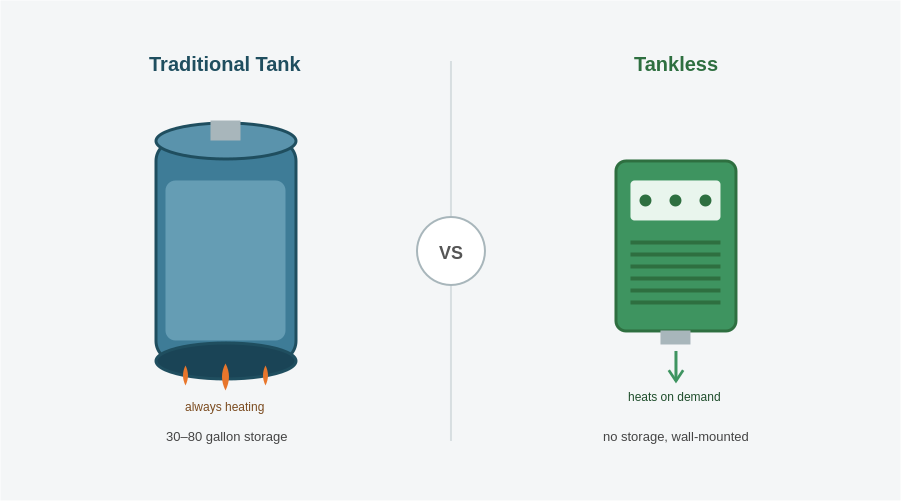
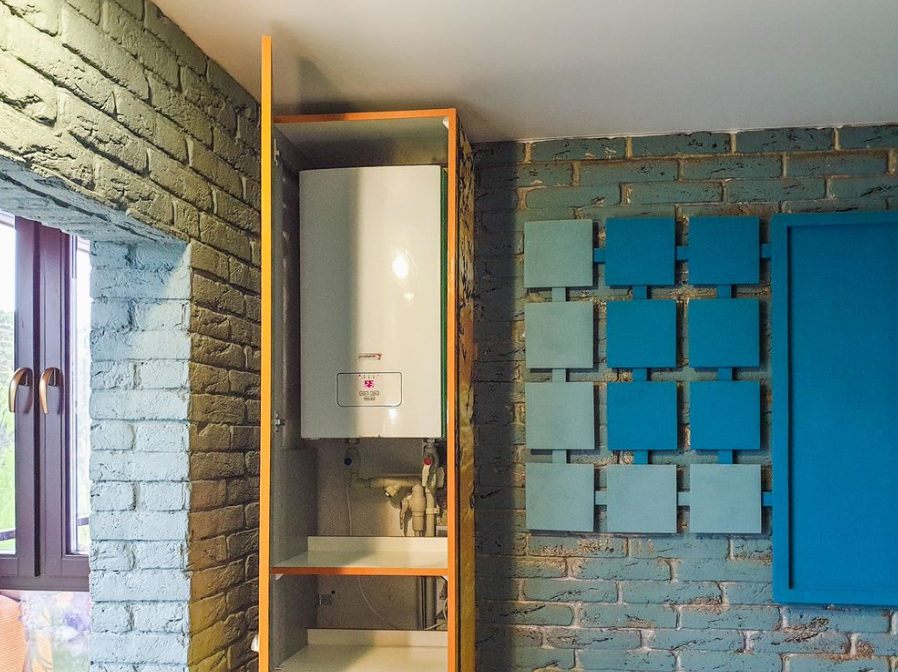
A traditional tank water heater stores 30 to 80 gallons of hot water and keeps it heated continuously, ready the moment you turn on a faucet. A tankless (or demand-type) water heater has no storage tank at all; cold water passes through a heat exchanger and is heated instantly, on demand, as you use it.
According to the U.S. Department of Energy, this design eliminates the standby energy losses that come from keeping a full tank of water hot around the clock.
What Each Option Costs Installed in 2026
| System Type | Equipment Cost | Total Installed Cost |
| Traditional gas tank (50-gallon) | $570 – $600 | $1,700 – $3,200 |
| Traditional electric tank | $400 – $1,200 | $1,200 – $2,500 |
| Gas tankless (retrofit) | $800 – $1,150 | $2,500 – $7,500 |
| Electric tankless (retrofit) | $525 – $1,800 | $1,400 – $4,500 |
The wide range of tankless installs isn’t padding; it reflects genuinely different scopes of work depending on what your home already has in place. Many homeowners get a base quote and are then surprised by what’s described below.
The Hidden Costs That Catch Homeowners Off Guard
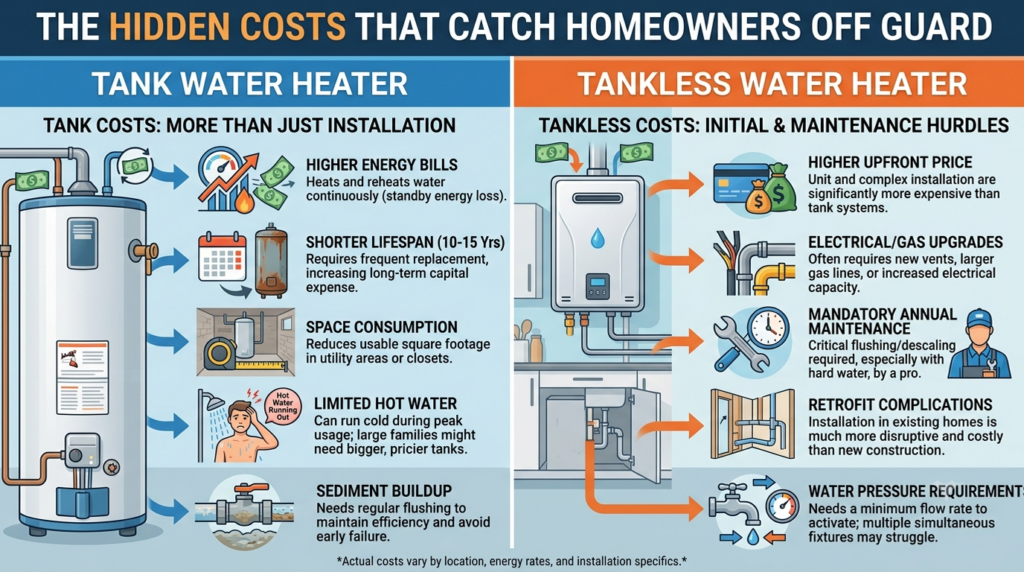
A straightforward tank-to-tank swap is mechanically simple: disconnect the old unit, connect the new one to the same vent and gas or electrical line, done.
Tankless retrofits are a different animal entirely, and the equipment price you see advertised online rarely reflects the full project cost.
Gas Line Upgrades
Tankless units demand significantly more gas flow in a short burst than a tank heater does. If your home’s existing gas line is undersized for that demand, expect to pay an additional $300 to $1,500 for a line upgrade.
Venting Changes
Gas tankless units typically require Category III stainless steel venting engineered to handle higher exhaust temperatures than a standard tank’s venting. This swap commonly adds $200 to $800 to the project.
Electrical Service Upgrades
Electric tankless models are remarkably power-hungry; some require a dedicated 200-amp service and multiple 240V circuits just to operate. If your panel doesn’t already have the capacity, budget $500 to $2,000 for a panel upgrade.
One contractor source compiling installation data across the country put it plainly: total hidden costs for tankless retrofits often run $1,000 to $6,500 beyond the advertised base price, according to a 2026 cost breakdown from C&C Air, compared to $200 to $1,000 in hidden costs for a tank replacement.
Energy Efficiency: The Numbers That Matter Long-Term
This is where tankless earns its premium. Per the Department of Energy, for homes using 41 gallons or less of hot water daily, demand water heaters can run 24% to 34% more energy efficient than storage tank models.
For higher-usage households (around 86 gallons per day), the efficiency advantage narrows to 8% to 14%, according to the DOE’s official guidance on demand-type water heaters.
ENERGY STAR estimates that a certified gas tankless unit saves a typical family of four around $95 per year, or roughly $1,800 over the unit’s lifetime, compared to a standard gas storage model, figures confirmed directly on ENERGY STAR’s official savings page.
Lifespan: The Number That Changes the Whole Equation
| Factor | Tank Water Heater | Tankless Water Heater |
| Average lifespan | 8 – 12 years | 15 – 20 years |
| Annual maintenance | Minimal | $150 – $400 (recommended flush) |
| Standby heat loss | Yes — constant | None |
| Simultaneous hot water use | Limited by tank size | Limited by flow rate (GPM) |
| Space required | Large floor footprint | Small, wall-mounted |
A tankless unit installed today will likely outlast two separate tank replacements over the same 20-year window.
That’s the core of the total-cost-of-ownership argument: pay more once, replace less often.
Real 20-Year Cost Comparison
One detailed 2026 industry breakdown ran the full math across two decades of ownership, factoring in replacement cycles, energy costs, and maintenance:
- Gas tankless system, 20-year total cost: $12,000 to $18,000
- Gas tank system, 20-year total cost (including two replacement cycles): $14,800 to $20,800
That comparison comes from a 2026 lifetime cost analysis from PlumbingSniper, and the typical payback period for choosing gas tankless over gas tank runs 7 to 12 years based on energy savings alone, shorter for high hot-water-demand households.
Rebates and Tax Credits Worth Checking Before You Buy
State utility rebates can add $100 to $1,000 on top of any federal incentive in many markets, and combined savings can knock a meaningful chunk off a tankless installation.
Before committing, check the ENERGY STAR Special Deals Finder for rebates available in your zip code, and confirm current federal credit eligibility through the IRS or a tax professional, since incentive programs change from year to year.
So Which One Should You Choose?
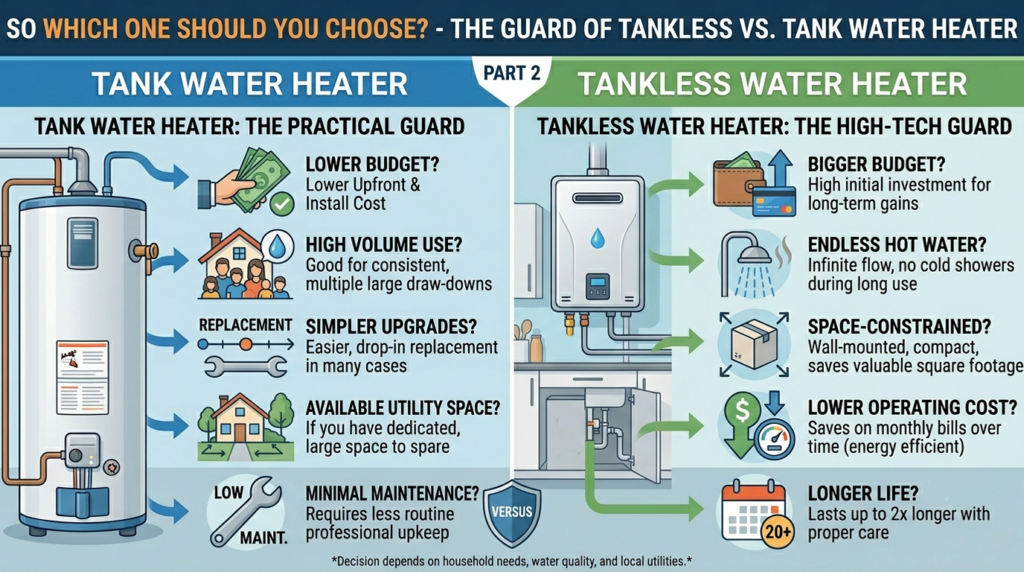
Choose a traditional tank if:
- You need the lowest possible upfront cost
- Your existing gas line, venting, and electrical service already match the new unit’s requirements
- You plan to sell or move within the next 5–8 years and won’t be around to recoup the efficiency savings
- Your household has very high simultaneous hot water demand (multiple showers + laundry + dishwasher running at once)
Choose tankless if:
- You’re planning to stay in the home long-term (the payback period is real, but it takes years)
- Your home’s hot water usage is moderate (under roughly 41 gallons/day) where the efficiency gain is largest
- Space is at a premium, tankless units are wall-mounted, and free up significant floor space
- You’re doing a larger renovation anyway, since gas line, venting, and electrical work can be bundled into the broader project cost
Bottom Line
Neither system is a universally “better” choice; they’re solving for different priorities. Tank heaters win on simplicity and upfront affordability. Tankless wins on long-term efficiency, lifespan, and space savings, provided your home’s infrastructure doesn’t require thousands in hidden upgrade costs. Get a written, itemized quote that explicitly covers gas line, venting, and electrical requirements before comparing prices — the headline number rarely tells the whole story.
