The first thing I noticed when I walked into my grandmother’s old house, before the smell, before the dated wallpaper, was the ceiling. That familiar bumpy, off-white texture that seems to absorb light and add twenty years to a room’s age just by existing.
Popcorn ceilings were everywhere from the 1950s through the late 1980s. Builders loved them: they were fast to spray on, hid imperfections in the drywall beneath, and dampened sound between floors. Practical. Efficient. Deeply ugly in retrospect.
If you’re living with them, you already know you want them gone. What you probably don’t know is exactly how much it’ll cost, what’s hidden underneath, and whether this is genuinely a DIY project or one of those things that sounds like a DIY project until you’re halfway through and covered in wet texture material.
This guide covers all of it honestly.
How Much Does Popcorn Ceiling Removal Cost in 2026?
The short answer: $1 to $6 per square foot, with most homeowners spending between $900 and $3,000 for a straightforward project.
Here’s what that looks like in practical terms:
| Room / Scope | Approx. Square Footage | Estimated Cost (Professional) |
|---|---|---|
| Single bedroom | 150 – 200 sq ft | $300 – $900 |
| Living room | 250 – 350 sq ft | $500 – $1,500 |
| Entire small home (under 1,000 sq ft) | 800 – 1,000 sq ft | $1,200 – $4,000 |
| Full-size home (1,500 – 2,000 sq ft) | 1,200 – 1,600 sq ft | $2,000 – $6,000 |
| High-end finish (scrape + skim coat + paint) | Per sq ft add-on | $3 – $6 per sq ft total |
The range reflects basic scraping vs. full scrape-skim coat-paint packages. Always clarify what’s included in any contractor quote.
The Factor That Can Quadruple Your Cost: Asbestos
Here’s the thing about popcorn ceilings that every homeowner with a pre-1986 house needs to understand before touching anything:
Asbestos was commonly used in textured ceiling sprays until the late 1970s, and products with existing asbestos inventory continued to be used into the mid-1980s. If your home was built before 1990, there’s a meaningful chance your popcorn ceiling contains asbestos fibers.
This doesn’t mean you’re in immediate danger. Undisturbed asbestos that’s in good condition poses minimal risk. The problem is what happens when you start scraping: you release fibers into the air.
If asbestos is present and removal is necessary, costs jump dramatically:
- Asbestos testing: $250 to $850 for professional sampling
- Asbestos abatement (removal): $9 to $20 per square foot compared to $1 to $6 for standard removal
- A 1,500 sq ft home ceiling with asbestos removal could run $15,000 to $30,000
What to do: Before any scraping DIY or otherwise, test a sample if your home was built before 1990. At-home test kits run $10 to $35 at hardware stores, though for a more reliable result, hire a certified industrial hygienist to collect the sample. The EPA’s guidance is clear: when in doubt, treat suspect material carefully and don’t disturb it without testing.
Breaking Down What You’re Actually Paying For
When a contractor quotes you popcorn ceiling removal, the quote may or may not include several additional steps. Always ask.
Step 1: Preparation: moving furniture, protecting flooring and walls with plastic sheeting, removing light fixtures. Some contractors include this; others charge extra.
Step 2: Scraping: The actual texture removal. Most contractors wet the ceiling in sections with a garden sprayer, let it soak for 10–15 minutes, and scrape with a wide drywall knife. Painted popcorn ceilings take longer because the paint seals the texture and prevents water absorption expect a 20–30% cost premium for painted surfaces.
Step 3: Skim Coating (May Be Extra). After scraping, the raw drywall beneath is rarely smooth you’ll see imperfections, trowel marks, screw holes, and tape lines. Skim coating (applying a thin layer of joint compound over the entire ceiling and sanding smooth) is what gives you that flat, contemporary look. It typically adds $1.50 to $3 per square foot to the project.
Step 4: Priming and Painting. Ceiling painting adds another $1 to $2 per square foot. Many homeowners skip the paint in the quote and handle it themselves, which is a reasonable way to save $300 to $600 on an average-sized home.
Can You DIY Popcorn Ceiling Removal?
Yes with important caveats.
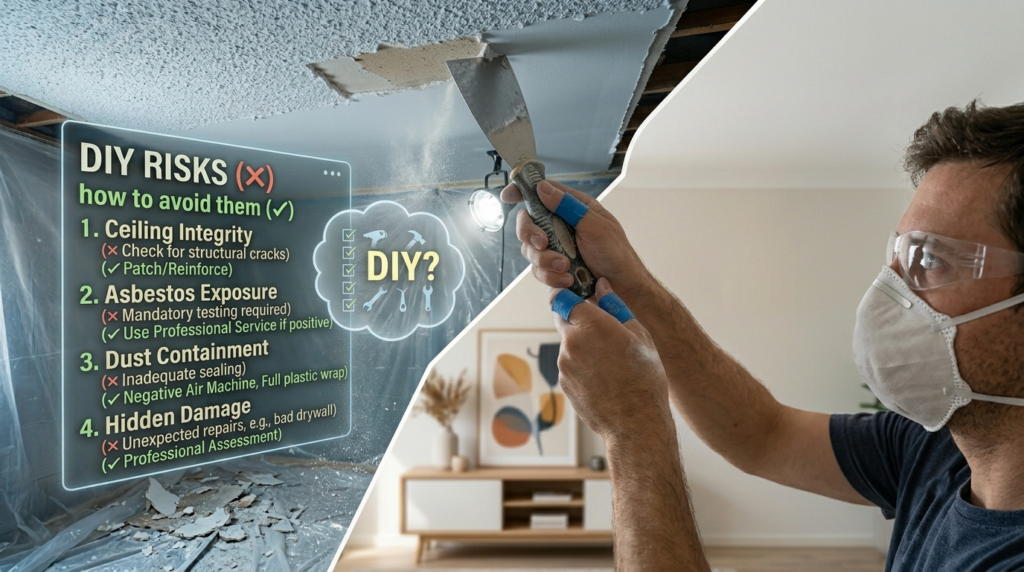
If your home was built after 1990 (or you’ve confirmed no asbestos through testing), popcorn removal is genuinely DIY-friendly. The technique is simple:
- Clear and protect the room. Cover floors and furniture with plastic sheeting. Remove light fixtures. Wear eye protection and a dust mask (N95 minimum).
- Fill a garden sprayer with warm water and lightly spray a 4×4-foot section of ceiling. Don’t soak it just dampen the texture.
- Wait 10–15 minutes for the water to penetrate and soften the texture.
- Scrape with a wide ceiling scraper (available at any hardware store for $15–$30). Work in the direction of the scraper, applying even pressure.
- Repeat in sections. Don’t try to do the whole room at once the texture will dry before you get to it.
- Fill gouges and imperfections with joint compound, let dry, sand smooth.
- Prime before painting. Bare, freshly scraped drywall will soak up paint unevenly without a primer coat first.
DIY materials cost: $200 to $500 for a full home, plus your time.
The honest caveat: The scraping itself is manageable. The skim coating step if you want a truly smooth ceiling is a real skill. Most first-timers end up with noticeable ridges and uneven patches. You may prefer to do the scraping yourself and hire a professional just for the skim coat. This hybrid approach can save 30–40% compared to full professional removal.
What About Just Covering It Instead?
If removal feels like too much especially in a room with an asbestos-positive ceiling where abatement costs are prohibitive there are covering alternatives:
Drywall overlay: Screw new sheets of 1/4-inch drywall directly over the existing textured ceiling. Tape and mud the seams, prime, and paint. This adds about 1/4 inch of ceiling height loss and costs $2 to $4 per square foot installed. The big advantage: asbestos stays contained beneath the new drywall without expensive abatement.
Wood planks / shiplap ceiling: Attach tongue-and-groove wood planks or beadboard over the existing ceiling. Works well aesthetically in the right style home and covers popcorn completely.
Stretch ceilings: A newer option gaining popularity a thin PVC membrane is stretched and attached to a perimeter track. Completely hides the existing ceiling. Costs $4 to $8 per square foot installed.
What’s the Most Popular Finish After Removal?
Once the popcorn is gone, you have choices about what comes next. The trends in 2026 lean heavily toward:
- Smooth matte finish: The clean, minimalist look. Requires skim coating. Most popular choice overall.
- Orange peel texture: A subtle texture that’s easier to achieve than smooth and hides minor imperfections. Good middle ground.
- Knockdown texture: A stepped, irregular pattern applied with a trowel. Popular in warmer climates.
- Wood plank or shiplap: Adds warmth and character; trending in farmhouse and transitional style homes.
- Coffered ceiling panels: A grid pattern that adds architectural interest. Works beautifully in living rooms and dining rooms.
How to Get an Accurate Quote
Three things to do before calling a contractor:
Measure your ceilings first. Know the square footage going in multiply room length by width. Contractors who won’t quote without an in-person visit (for a job this size) are being appropriately cautious; ones who give firm phone quotes without seeing the job may be making up numbers.
Ask specifically about asbestos. A reputable contractor will ask about your home’s age and may recommend or require testing before committing to a price.
Get line-item quotes, not package deals. Ask for separate pricing on: scraping, skim coating, priming, painting, debris disposal. This lets you compare apples to apples across multiple bids and identify where you can DIY to save money.
The Bottom Line
Popcorn ceiling removal is one of those projects that transforms a room more than you’d expect. It’s remarkable how much lighter, taller, and more contemporary a room feels after that bumpy texture comes down.
Key takeaways:
- Budget $1 to $3 per sq ft for basic scraping, $3 to $6 per sq ft for scrape + skim coat + paint
- Test for asbestos before doing anything if your home was built before 1990
- DIY is genuinely viable for post-1990 homes; skim coating is the hardest part to do well
- Covering with 1/4-inch drywall is a legitimate option when asbestos abatement is cost-prohibitive
- Always get a line-item quote so you know exactly what’s included
ALSO READ: How to Convert Your Garage Into a Living Space (Without Blowing Your Budget)
