
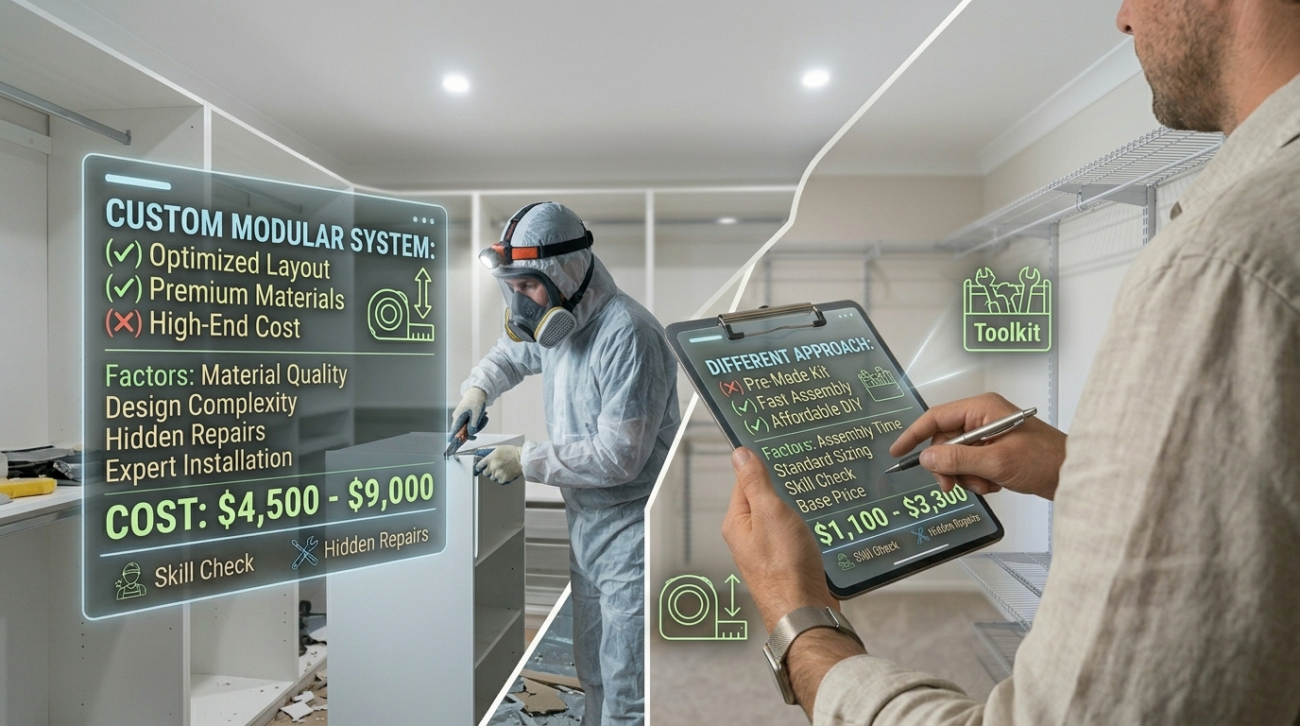
There’s a particular kind of frustration that comes from owning a closet that’s technically big enough but functionally useless. A single rod, one shelf above it, and a floor that becomes a graveyard for shoes, off-season coats, and that one box you’ve been meaning to deal with since you moved in.
The fix isn’t a bigger closet. It’s a smarter one. And the gap between “wire shelf from the hardware store” and “five-figure custom build-out” is wider than most homeowners realize which means there’s almost certainly an option that fits your space, your budget, and how you actually live.
This guide breaks down every tier of closet organization system available in 2026, what each one actually costs installed, and how to figure out which is worth your money.
The Four Tiers of Closet Systems
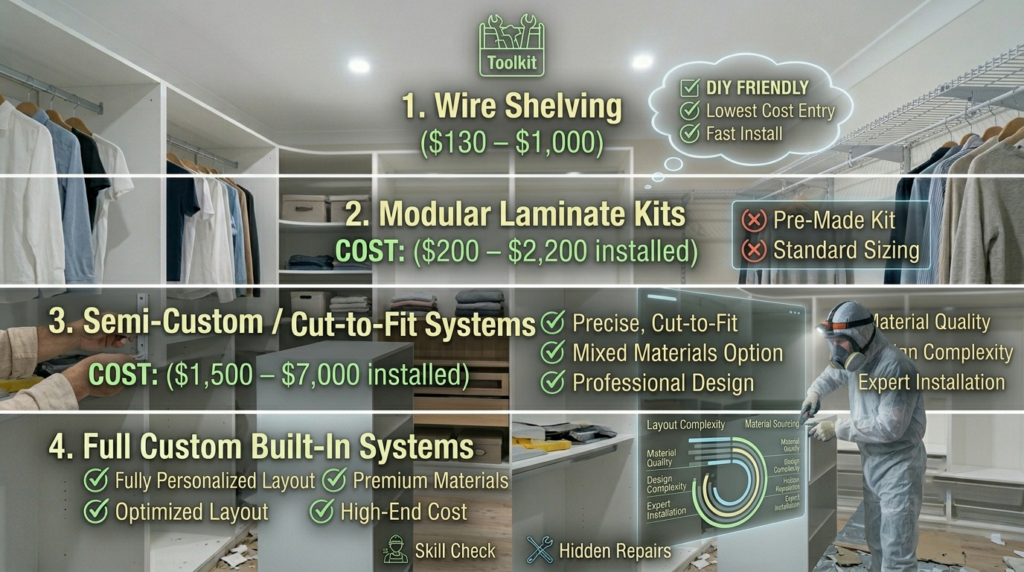
Tier 1: Wire Shelving ($130 – $1,000)
This is the system most of us grew up with the white or chrome wire shelving you’ll find in nearly every builder-grade home built in the last 40 years. It’s not glamorous, but it’s cheap, it’s durable, and it allows air circulation, which makes it genuinely useful in laundry closets or anywhere humidity is a concern.
Pros: Lowest cost, widely available, easy to install yourself, good airflow.
Cons: Looks utilitarian, small items fall through the wire gaps, doesn’t maximize visual storage the way solid shelving does.
Best for: Linen closets, laundry rooms, secondary closets, rental properties, budget-conscious primary closets.
Tier 2: Modular Laminate Kits ($200 – $2,200 installed)
This is the IKEA PAX / ClosetMaid SuperSlide tier pre-made laminate or particleboard components you assemble and mount yourself, or have installed for a modest labor fee.
The real-world catch most people don’t anticipate: these systems come in fixed-width modular boxes. If your closet wall measures 105 inches and you buy two 50-inch units, you’re left with a 5-inch gap you’ll need to fill with a filler strip or just live with. Precision fit isn’t really the point of this tier speed and affordability are.
Pros: Significantly more storage capacity than wire alone (drawers, shoe shelves, double-hang sections), reasonably priced, good aesthetic upgrade for the cost.
Cons: Gaps if your closet dimensions don’t match standard module widths, can sag under heavy seasonal loads if overloaded, particleboard doesn’t hold up as well as solid wood over the long term.
Best for: Reach-in closets, homeowners who want a meaningful upgrade without a major investment, anyone planning to move within the next several years.
Tier 3: Semi-Custom / Cut-to-Fit Systems ($1,500 – $7,000 installed)
This tier closes the gap-and-filler-strip problem entirely. Cut-to-fit systems use the same general materials as modular kits (laminate, thermally fused laminate, sometimes solid wood components) but are sized to your exact closet dimensions rather than snapped together from fixed-width boxes.
You’ll typically work with a designer (sometimes in-store, sometimes a company representative who visits your home) who measures your space and configures drawers, shelving, hanging sections, and accessories to use every inch.
Pros: No wasted space, better fit and finish than modular kits, can include soft-close drawers, integrated lighting, and specialty storage (jewelry trays, tie racks, shoe cubbies), strong middle-ground value.
Cons: Higher cost than modular, installation typically requires professional measurement and assembly, longer lead time (often 2–6 weeks from order to install).
Best for: Walk-in closets, primary bedroom suites, homeowners planning to stay in the home for 5+ years, anyone who’s tired of “almost right” storage solutions.
Tier 4: Full Custom Built-In Systems ($6,000 – $20,000+)
At the top of the market, fully custom closets use solid wood construction (often supporting 1,200+ pounds of hanging and shelf load), integrated LED lighting, glass-front cabinetry, decorative crown molding, and floor-to-ceiling trim that makes the closet feel like an extension of the home’s architecture rather than a storage afterthought.
This is the tier where “his and hers” islands, built-in vanities, and dedicated handbag or shoe display walls live.
Pros: Maximum durability and longevity, fully bespoke to your exact needs, meaningfully boosts home value in luxury markets, no modular compromises anywhere.
Cons: Significant cost premium much of which goes toward design consultation, premium materials, and professional installation rather than raw material cost, longest lead time of any tier.
Best for: Primary suites in higher-end homes, homeowners who view the closet as a design feature rather than pure storage, anyone planning a forever-home renovation.
Quick Comparison Table
| Tier | Cost Range (Installed) | DIY Possible? | Best For |
|---|---|---|---|
| Wire Shelving | $130 – $1,000 | ✅ Yes, very easy | Linen closets, rentals, budget reach-ins |
| Modular Laminate | $200 – $2,200 | ✅ Yes, moderate effort | Reach-in closets, mid-budget upgrades |
| Cut-to-Fit Semi-Custom | $1,500 – $7,000 | ⚠️ Usually professionally installed | Walk-in closets, long-term homeowners |
| Full Custom Built-In | $6,000 – $20,000+ | ❌ No, requires specialists | Luxury primary suites, forever homes |
The DIY Option Nobody Talks About
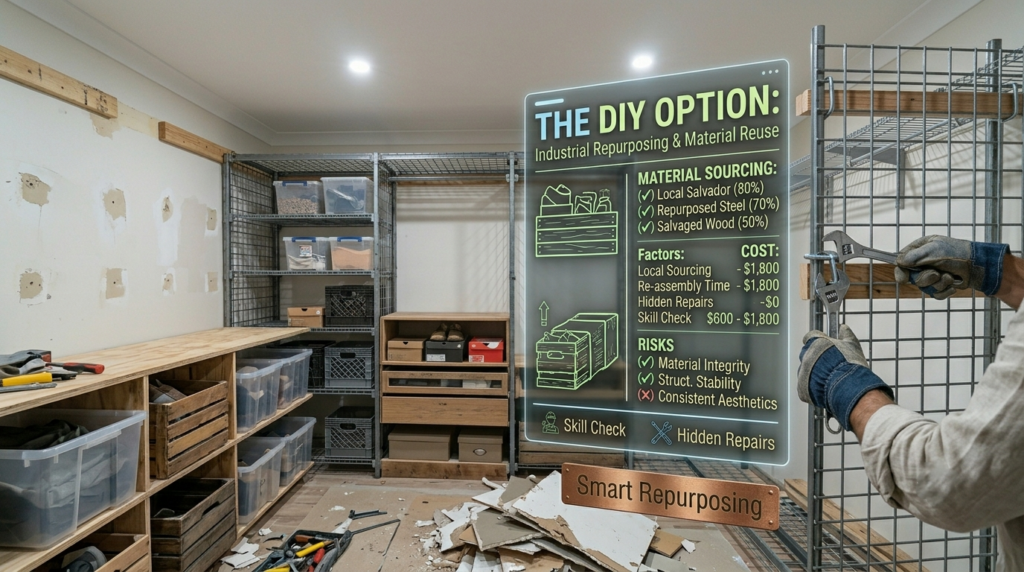
If your budget is genuinely tight, you don’t have to choose from a catalog at all. A fully DIY closet build using standard lumber, brackets, and paint can run as little as $50 to $150 in materials for a basic reach-in closet, plus a weekend of your time.
The trade-off is obvious: you’re trading money for labor and design flexibility for your own woodworking skill level. But for a renter who needs a functional closet without sinking money into a space they don’t own, or a homeowner with genuine carpentry skills, this remains a completely legitimate path.
What you’ll need for a basic DIY build:
- 1×12 or 1×10 lumber for shelves ($15–$30 per shelf depending on length and wood type)
- Closet rod and brackets ($10–$25)
- Shelf brackets or a cleat system ($10–$20)
- Wood screws, wall anchors, level, drill
A simple double-shelf-and-rod configuration for a standard reach-in closet typically uses 3–4 boards and can be completed start to finish in an afternoon.
How to Decide Which Tier Is Right for You
Ask yourself these three questions before you spend a dollar:
1. How long are you staying in this home? If the answer is under 3 years, the cost-to-benefit math strongly favors Tier 1 or Tier 2. You won’t recoup a $10,000 custom closet investment on a short timeline, and a quality modular system can be disassembled and taken with you if you choose certain brands.
2. Does your closet have unusual dimensions or angles? Sloped ceilings, narrow widths, or oddly placed support beams make modular kits frustrating to work with you’ll spend more time fighting gaps and filler strips than you would just going semi-custom from the start. Irregular spaces are where cut-to-fit systems earn their higher price tag.
3. Is this a “function” closet or a “feature” closet? A hallway linen closet or a kid’s bedroom closet is a function closet it needs to work, not impress anyone. A primary suite walk-in that you see every single morning, and that potential buyers will eventually walk through, is a feature closet. Spend accordingly.
Hidden Costs to Watch For
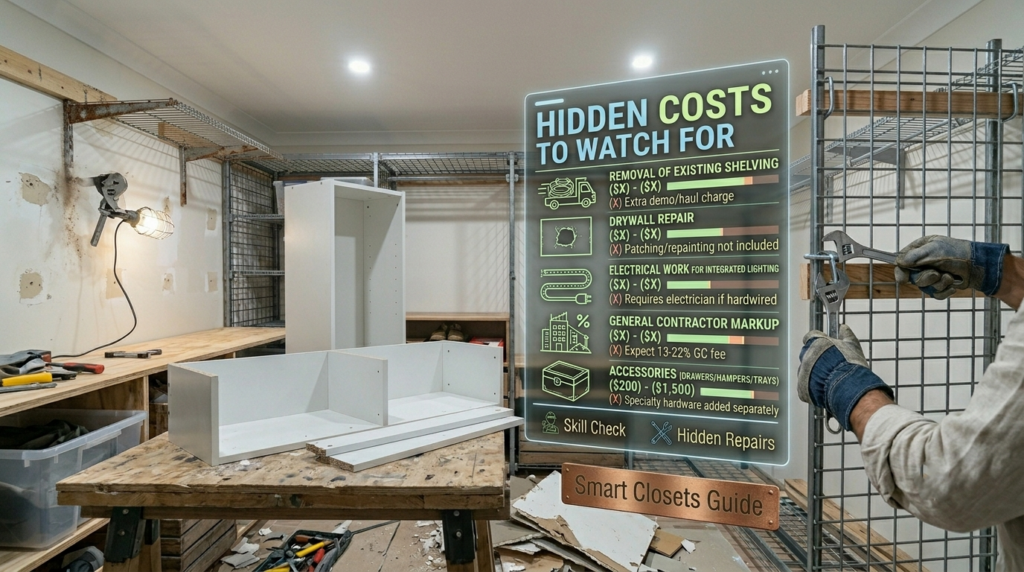
Closet system quotes can look deceptively simple until the line items start adding up. Watch for these:
- Removal of existing shelving: Some installers charge extra to demo and haul away your old wire shelving before installing the new system.
- Drywall repair: If old shelving brackets leave holes or damage, patching and repainting may not be included in your quote.
- Electrical work for integrated lighting: LED strip lighting looks fantastic but often requires an electrician if it’s hardwired rather than battery-powered.
- General contractor markup: If a GC is supervising your closet installation as part of a larger renovation, expect 13% to 22% added to the closet line item alone.
- Accessories: Soft-close drawer mechanisms, pull-out hampers, jewelry trays, and specialty hardware are frequently quoted separately and can add $200 to $1,500 to an otherwise reasonable estimate.
A Word on Resale Value
A genuinely well-organized closet system does measurably help at resale buyers consistently rank storage as a top priority, and a primary closet that looks like a boutique dressing room rather than a wire-shelf afterthought creates an emotional reaction during showings that’s hard to manufacture any other way.
That said, the ROI math favors mid-range systems over ultra-luxury ones in most markets. A $3,000 to $5,000 cut-to-fit semi-custom closet tends to recoup more of its cost at resale, proportionally, than a $15,000 fully custom build unless you’re in a luxury market where buyers specifically expect that level of finish throughout the home.
The Bottom Line
You don’t need to choose between “cheap wire shelving” and “five-figure custom closet” there’s a meaningful, well-built tier in between that fits almost every budget and timeline. Start by measuring your space accurately, decide honestly whether this is a function closet or a feature closet, and match your spending to how long you’ll actually be enjoying the result.
ALSO READ: Popcorn Ceiling Removal: Real Costs, What Nobody Tells You, and Whether to DIY
