
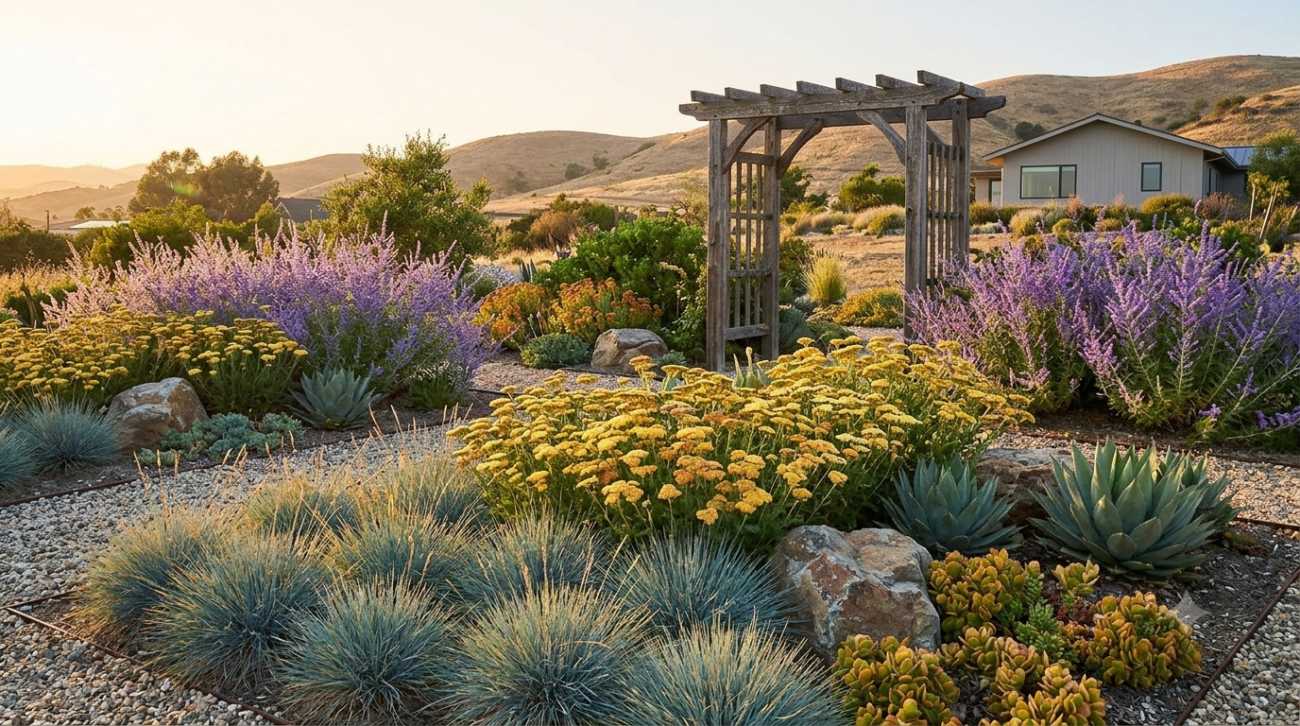
A traditional lawn is, objectively speaking, one of the most resource-intensive things a homeowner can maintain. It needs water every few days in dry spells, fertilizer, mowing every week or two through the growing season, and aeration annually just to keep from compacting into a surface that sheds water rather than absorbing it. In return, it gives you a green surface that looks roughly the same from May to September, can’t be walked on immediately after treatment, and turns brown the moment water is restricted.
Drought-tolerant landscaping — more formally called xeriscaping — solves this with a different premise: design the garden around plants that have already adapted to dry conditions, add the right mulch and hardscape, and let the local climate do most of the maintenance work. Fully established xeriscape plantings typically need 50% to 70% less water than a conventional lawn, often at no reduction in visual interest.
Drought-Tolerant Landscaping: Design, Cost, and Where to Start
What It Costs
According to Angi’s xeriscape cost data, a full front lawn xeriscape design averages $11,000 to $15,000 for professional installation — a significant investment offset by measurably lower water and maintenance costs over time. Lawn Love’s national average puts the figure slightly higher at around $17,000 including labor and materials for a standard-size yard, though projects are easily phased to fit any budget.
| Project Scope | Estimated Cost Range | Notes |
| Small front strip / border (200 sq ft) | $800 – $2,500 | Good starting point; highly visible impact |
| Full front lawn conversion (800–1,200 sq ft) | $8,000 – $18,000 | Includes plant material, mulch, drip irrigation |
| Full property xeriscape (2,000+ sq ft) | $15,000 – $30,000+ | Most complete water savings; largest upfront cost |
| DIY phased approach (materials only) | $1,500 – $5,000 | Your labor; significantly lower cost per area |
The DIY path is genuinely viable for xeriscape work — most of the tasks (removing turf, amending soil, planting, mulching) require no specialized skills or equipment. The biggest cost item in a professional install is typically labor for sod removal and soil preparation, both of which are manageable weekend projects.
The Seven Principles of Xeriscape Design

Xeriscape isn’t just “plant cacti and spread gravel.” A well-executed drought-tolerant garden is a coherent design system. The following seven principles, outlined in the Plant Proven Winners drought-resistant landscaping guide, provide a practical framework for any scale project:
- Create a plan first: Identify sun/shade zones, drainage patterns, and existing soil type before purchasing any plants. Note where water currently pools after rain — this is where moisture-tolerant plants will thrive even in a xeriscape.
- Reduce or eliminate lawn: Turf grass is the single biggest water consumer in most residential landscapes. Partial or full lawn replacement delivers the largest reduction in water use.
- Improve soil: Work 2 to 3 inches of compost into existing soil before planting. Better-structured soil retains moisture longer and gives roots access to water reserves deeper in the ground.
- Hydrozone — group plants by water need: Place drought-tolerant plants in sunny, exposed areas; reserve any higher-water plants for naturally shaded or lower spots where moisture lingers. This prevents overwatering drought-tolerant plants while neglecting thirstier ones.
- Mulch deeply: Two to three inches of mulch (organic wood chip or inorganic decomposed granite) dramatically reduces evaporation from the soil surface. This single step can reduce supplemental watering by 25% to 30%.
- Use efficient irrigation: Drip irrigation delivers water directly to the root zone and eliminates the evaporation losses of sprinkler systems. A basic drip system for a front yard typically runs $200 to $700 installed.
- Maintain appropriately: During establishment (first 1 to 2 years), drought-tolerant plants still need regular deep watering to develop their root systems. Once established, they survive on significantly less — but establishment is the phase most homeowners underestimate.
The Best Plants for a Drought-Tolerant Garden
According to a 2026 comprehensive plant guide from Yardcast and the Gardenia drought garden guide, the most reliable drought-tolerant perennials for most U.S. climate zones include:

| Plant | Zones | Standout Quality |
| Lavender | 5–9 | Aromatic, pollinators, Mediterranean look |
| Russian sage (Perovskia) | 5–9 | Tall, feathery, long bloom season |
| Purple coneflower (Echinacea) | 3–9 | Native, wildlife value, easy to grow |
| Yarrow (Achillea) | 3–9 | Tough, spreads well, many color options |
| Little bluestem grass | 3–9 | Native prairie grass, striking fall color |
| Agave | 8–11 | Architectural statement, near-zero water once established |
| California lilac (Ceanothus) | 7–10 (West) | Stunning bloom, key for western gardens |
| Sedum (Stonecrop) | 4–9 | Fleshy, succulent, excellent groundcover |
Hardscape Elements That Do Double Duty
The non-plant elements of a xeriscape aren’t just filler — they’re functional components that reduce water use and add visual structure:
- Decomposed granite (DG): The signature ground cover of xeriscape gardens. Suppresses weeds, allows rain to penetrate into soil, and reflects or retains heat depending on color choice. Costs around $40 to $60 per cubic yard for materials.
- Dry riverbeds: A channel of river rock that directs stormwater away from structures and toward planting zones. Visually striking and functional — it’s both a drainage solution and a design feature.
- Boulders: Large rocks create microhabitats by shading soil on the north side, collecting rainfall runoff, and providing visual anchors. They genuinely reduce water needs in the surrounding soil by decreasing evaporation.
- Permeable pavers: Allow rain to filter through rather than running off — useful on paths and driveways adjacent to planting areas where you want to direct water toward root zones.
Water Savings: The Real Numbers
Multiple sources converge on similar figures. Once established, xeriscape plantings can reduce outdoor water use by 50% to 70% compared to a conventional lawn — with HGTV’s drought-tolerant landscaping guide noting that in arid climates, combined savings from drip irrigation, smart controllers, and drought-tolerant plants can eliminate supplemental irrigation almost entirely during established seasons.
In practical terms: a household that currently uses 10,000 gallons of water per month on outdoor irrigation during summer could reduce that to 3,000 to 5,000 gallons after a full xeriscape conversion — a meaningful reduction in both the environmental footprint and the water bill.
Rebates: The Money Most Homeowners Leave Behind
Many municipal water authorities and utility companies offer direct rebates for lawn-to-xeriscape conversions. As noted in Progressive Landscapers’ California cost calculator, California homeowners can often qualify for rebates up to $3 per square foot through agencies like LADWP and EBMUD — which on a 1,000 square foot conversion translates to $3,000 in direct rebates against your project cost. Similar programs exist in Colorado, Texas, Arizona, and other states with water-stressed regions. Search your local water utility’s website for a turf removal or water-wise landscaping rebate program before beginning any conversion work.
Phased Approach: How to Start Without a Full Budget
The most common mistake in xeriscape planning is treating it as an all-or-nothing project. A phased approach over two to three years can achieve the same end result for a fraction of the upfront cost:
- Year 1: Remove the strip of lawn between the sidewalk and the house (the “hellstrip”). This is the hardest area to water efficiently and the most visible — replacing it with a drought-tolerant planting makes an immediate visual statement and eliminates one of the most wasted watering zones in a typical property.
- Year 2: Convert the front lawn. Install drip irrigation. Add decomposed granite or organic mulch as a base layer.
- Year 3: Tackle backyard irrigation zones. Add hardscape elements. Refine plant selection based on what thrived in years one and two.
Each phase is largely self-funding through reduced water bills and lower maintenance costs, which makes the cumulative investment more manageable than the full-project number suggests.
Bottom Line
A full professional xeriscape conversion runs $11,000 to $17,000 for an average-sized property, with meaningful payback through reduced water bills and near-zero lawn maintenance costs. The DIY path costs a fraction of that. Either way, the establishment phase requires patience — the first two years will look different from year five, when plants have filled in and the design reads as intentional rather than freshly planted. The payoff is a garden that genuinely thrives on neglect, looks good in drought years, and requires a small fraction of the resources a traditional lawn demands.
