
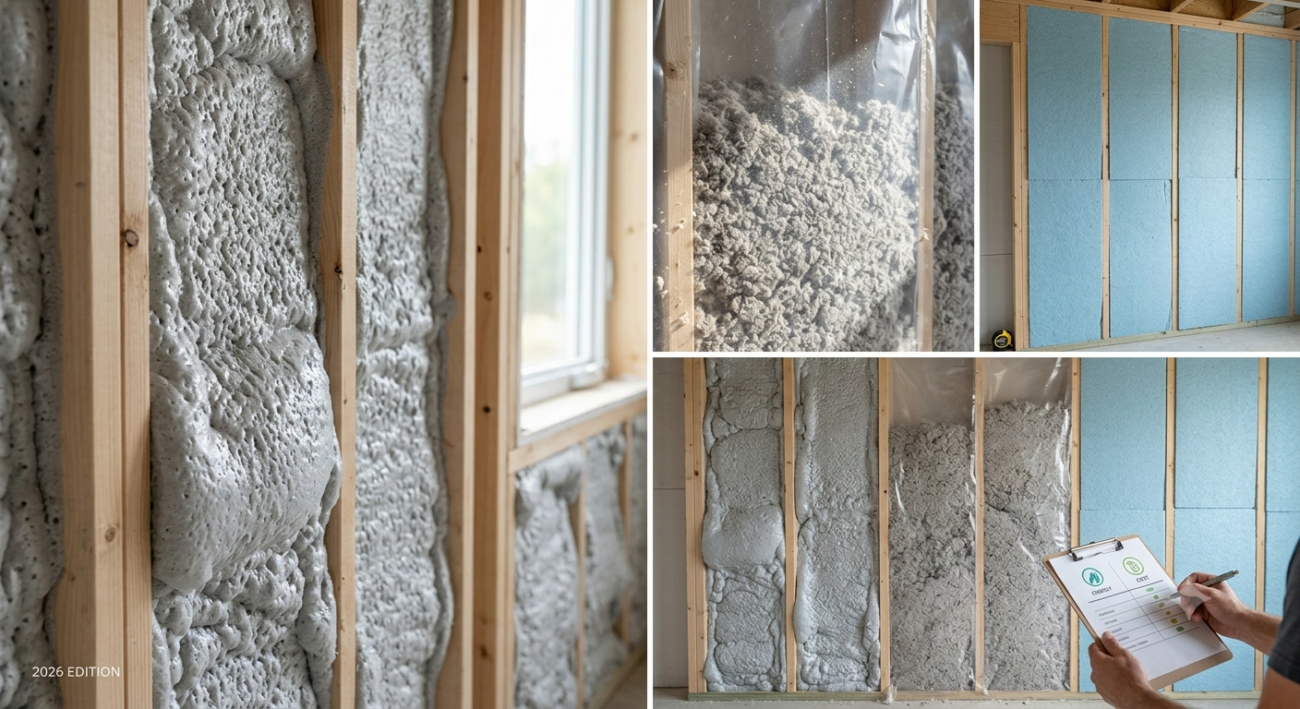
Insulation is one of those home investments that works invisibly — you never see it doing its job, but you feel it every month in your energy bill and every time a room holds its temperature despite what’s happening outside. The problem is that “insulation” covers three genuinely different product categories that perform differently, cost differently, and suit different applications. Choosing the wrong one for your situation doesn’t just cost more upfront — it can mean underperforming insulation that you’ll be living with for the next twenty years.
Here’s a direct comparison of all three major types, grounded in current 2026 pricing and performance data, with a clear answer for which works best where.
Insulation Types Compared: Performance, Cost, and Best Use Cases
The Three Types at a Glance
A detailed 2026 side-by-side analysis from FieldCamp distills the core differences clearly: spray foam leads in R-value and air sealing, blown-in excels at retrofit versatility, and batts win on upfront affordability for open framing. No single type is universally better — the right choice depends on what you’re insulating and what problem you’re solving.

| Type | R-Value Per Inch | Air Sealing | Cost Per Sq Ft | DIY Possible? |
| Fiberglass batt | R-2.9 – R-3.8 | None | $0.30 – $1.50 | Yes |
| Blown-in cellulose | R-3.2 – R-4.3 | Partial | $0.40 – $2.50 | Rentable blower |
| Open-cell spray foam | R-3.7 per inch | Complete | $0.75 – $2.00 | No — pro only |
| Closed-cell spray foam | R-5.6 – R-8.0 | Complete + vapor barrier | $1.50 – $4.50 | No — pro only |
Fiberglass Batt Insulation
The pink or yellow fluffy rolls you’ve seen in every hardware store are fiberglass batts — pre-cut sections designed to friction-fit between wall studs and ceiling joists. They’ve been the residential insulation default for generations because they’re cheap, DIY-friendly, and available everywhere.
Where Batts Perform Well
- New construction with open, accessible stud bays before drywall goes up
- Attic floors with standard joist spacing and unlimited depth for adding R-value
- Interior partition walls where moisture control isn’t a concern
- Budget-constrained projects where performance is secondary to cost
The Critical Installation Warning
Per InsulationRValues.com’s 2026 technical guide, never compress fiberglass batts to fit a thinner cavity. A batt rated R-19 compressed from 6.25 inches to 3.5 inches drops to roughly R-13 — a 32% performance loss from one common installation mistake. Always match batt thickness to cavity depth.
The bigger limitation of batts is what they don’t do: they provide no air sealing. Gaps as small as 5% can reduce effective R-value by 25% or more in practice, per FieldCamp’s analysis. A wall insulated with R-13 fiberglass batts but with gaps around outlets, pipes, and top plates can perform like R-9 or worse in a real home.
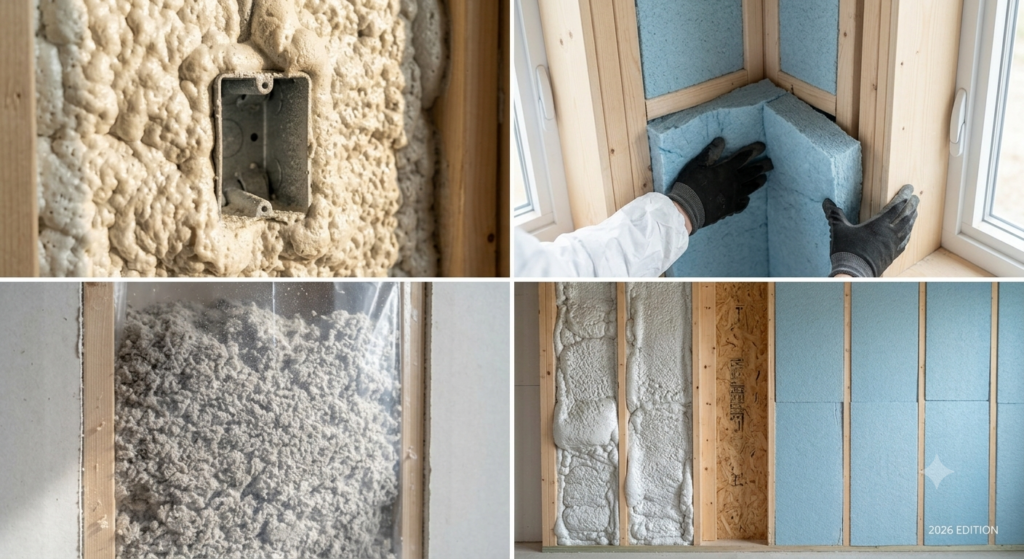
Blown-In Cellulose Insulation
Blown-in loose-fill insulation — most commonly cellulose made from recycled newspaper treated with fire retardants — is pneumatically installed using a blower machine. It fills irregular spaces that batts miss: around wiring, pipes, irregular joist spacing, and hard-to-reach attic corners.
Where Blown-In Shines
- Open attics: The most cost-effective way to reach high R-values (R-49 to R-60) over a large area. Per InsulationRValues.com, a 1,000 sq ft attic to R-49 costs $1,200 to $3,500 with blown-in cellulose vs. $4,500 to $7,000 with closed-cell spray foam — same R-value at 2 to 5 times lower cost
- Existing wall retrofit without removing drywall: Dense-pack blown-in is the go-to retrofit solution — a contractor drills small holes in the exterior siding (or interior drywall), fills the cavity completely, then patches the holes
- Budget-conscious attic upgrades: For open attic floors where there’s no depth constraint, blown-in consistently delivers the best value
The Main Limitation
Blown-in cellulose provides partial air sealing — better than batts, but not the airtight seal spray foam delivers. It also settles slightly over years, which can reduce effective R-value in wall applications over the long term.
Spray Foam Insulation
Spray polyurethane foam (SPF) is applied as a liquid that expands and hardens to seal every crack and cavity it contacts. It’s the performance leader across R-value, air sealing, and moisture resistance — and the most expensive option by a significant margin.
Per One Click DIY’s 2026 cost comparison, spray foam typically costs two to three times more upfront than blown-in or batt insulation but can cut heating and cooling costs by 30% to 50% — and the U.S. Department of Energy estimates that proper insulation combined with air sealing reduces heating and cooling costs by 15% to 25% overall, with air sealing alone accounting for 10% to 20% of those savings.
Open-Cell vs. Closed-Cell: The Key Distinction
These aren’t interchangeable products — they suit different applications:
- Open-cell spray foam (R-3.7/inch): Softer, less expensive, excellent air barrier, vapor-permeable (moisture can pass through). Best for interior walls, interior side of roof decking in conditioned attic applications.
- Closed-cell spray foam (R-5.6 to R-8.0/inch): Rigid, higher R-value, acts simultaneously as air barrier AND vapor barrier. The only insulation that does all three jobs in one layer. Best for basements, crawl spaces, below-grade walls, and any application where moisture resistance is critical.
The Flash-and-Batt Strategy Worth Knowing

Per InsulationRValues.com’s analysis, a popular cost-saving hybrid approach — called “flash and batt” — applies 2 inches of closed-cell spray foam on the sheathing side of a wall cavity (providing the critical air and vapor barrier at R-12 to R-14), then fills the remaining cavity depth with fiberglass batt. The result is roughly R-25 in a 2×6 wall at 40% to 60% of the cost of full closed-cell spray foam — capturing most of spray foam’s performance advantage at a much lower price point.
Where Spray Foam Is the Clear Winner
- Basement and crawl space walls where moisture control and high R-value in limited depth are both required
- Rim joists — the most air-leaky area in most homes; a small amount of closed-cell foam seals and insulates in one step
- Limited-depth wall cavities where no other material can reach the required R-value
- Conditioned attic assemblies where the insulation needs to go at the roof deck rather than the attic floor
A Decision Guide: Which One For Which Job
| Location / Situation | Best Choice | Reason |
| Open attic (accessible flat floor) | Blown-in cellulose | 2–5x cheaper than spray foam for same R-value |
| New construction walls (open framing) | Fiberglass batt or flash-and-batt | Lowest cost for open, dry interior cavities |
| Existing walls (retrofit, no demo) | Dense-pack blown-in | Fills without removing drywall |
| Basement/crawl space walls | Closed-cell spray foam | Moisture resistance + high R-value in limited depth |
| Rim joists | Closed-cell spray foam | Small area; air sealing + insulation in one step |
| Cathedral ceiling / roof deck | Closed-cell or flash-and-batt | Limited depth; moisture management critical |
| Budget-constrained new construction | Fiberglass batt + separate air sealing | Lowest upfront cost; pair with caulk and foam for gaps |
The Air Sealing Point That Changes the Whole Calculation
The U.S. Department of Energy’s guidance is explicit on this point, cited directly in FieldCamp’s analysis: “Before you insulate, you should make sure that your home is properly air sealed.” This isn’t just a precaution — it fundamentally changes which insulation type makes sense. If you’re planning to air seal separately anyway (caulk, foam can, gaskets around outlets and penetrations), then fiberglass batts and blown-in cellulose perform much closer to their rated R-values, and the premium for spray foam’s integrated air sealing matters less.
If you’re not planning to air seal separately — or the location makes separate air sealing impractical (a rim joist, a crawl space wall, a cathedral ceiling) — spray foam’s integrated sealing is what earns its price premium.
Long-Term Cost: What Spray Foam’s Payback Period Actually Looks Like
Per Foam Insulation Solution’s 2025 analysis, spray foam typically pays for itself through energy savings in 5 to 10 years depending on climate and energy costs — and unlike fiberglass batts (lifespan 15 to 20 years), closed-cell spray foam never needs replacement and never settles or degrades, per Sprayman’s 2025 longevity data. In the locations where spray foam is genuinely the right tool — crawl spaces, rim joists, basement walls — the long-term math consistently favors it over the alternatives.
Bottom Line
Match the insulation type to the job rather than defaulting to one type across every application in the house:
- Open attic with lots of depth? Blown-in cellulose — cheapest path to a high R-value.
- New construction open walls? Fiberglass batt — lowest cost; pair with proper air sealing.
- Existing walls, no demo? Dense-pack blown-in — retrofit without opening anything.
- Basement, crawl space, rim joists, or cathedral ceilings? Closed-cell spray foam — the only material that handles moisture and limited depth simultaneously.
- Whole-house performance on a budget? Flash-and-batt hybrid — 40% to 60% lower cost than full spray foam with most of the performance gains.
