
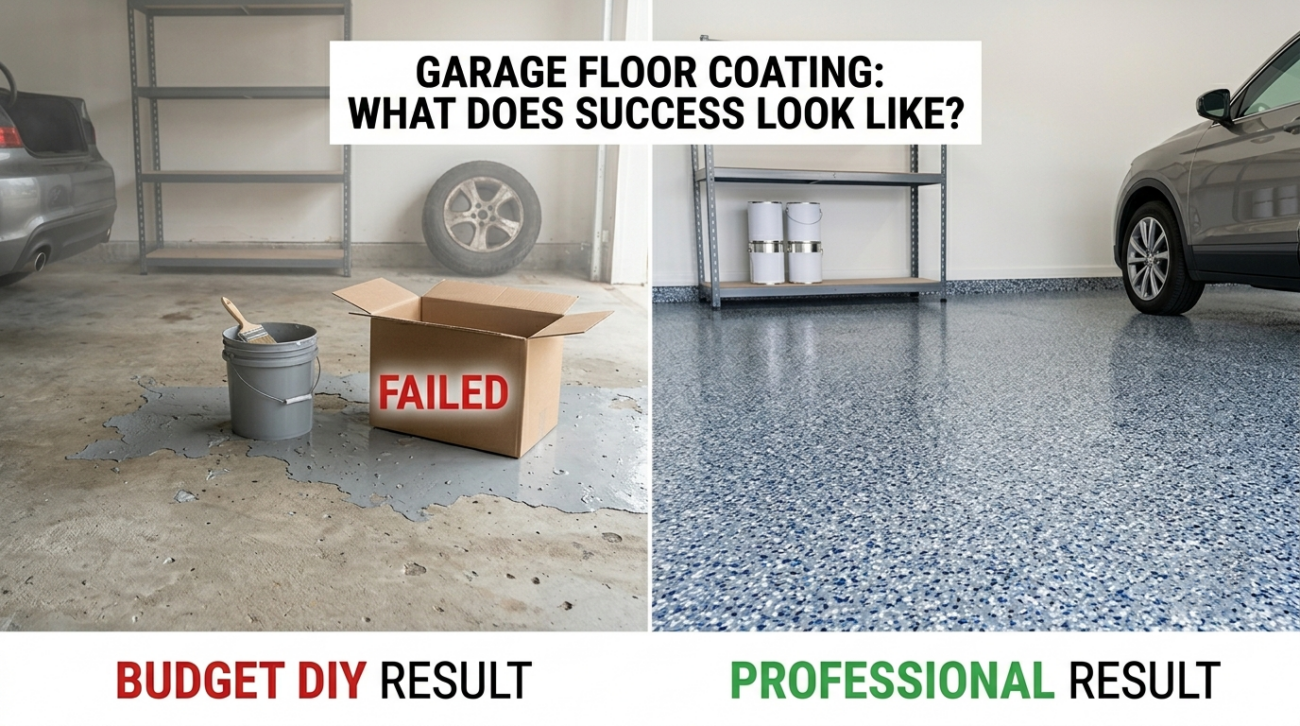
Walk into any home improvement store, and you’ll find epoxy garage floor kits stacked near the paint aisle, priced low enough to feel like an easy weekend win. Walk into a garage six months after a failed DIY attempt, and you’ll see exactly why so many of those kits end up getting redone professionally: peeling at the tire tracks, bubbling near the garage door, a hot tire pulling up a strip of coating like a sticker.
This isn’t an argument against DIY. It’s a breakdown of what separates a floor that lasts fifteen years from one that fails in eighteen months, so you can make the call with real information instead of guessing.
What It Costs: DIY vs. Professional
| Approach | Cost Range | Typical Lifespan |
| DIY kit (water-based epoxy paint) | $50 – $600 | 1 – 3 years before peeling/bubbling |
| DIY kit (100% solids epoxy) | $390 – $1,460 | 5 – 10 years with proper prep |
| Professional (standard 2-car garage) | $1,600 – $6,000 | 10 – 15+ years |
| Professional (premium, commercial-grade) | $5,200 – $8,400 | 15 – 20+ years |
According to Angi’s 2026 cost data, professional labor alone accounts for 33% to 60% of total project cost, which is exactly the portion a DIY approach eliminates, but that labor is doing more than just rolling on coating.
Why DIY Epoxy Kits Fail So Often
This is the part most DIY guides gloss over. One contractor’s detailed 2026 breakdown, drawn from 400 professional installs and direct experience repairing failed DIY jobs, states plainly that 65–75% of the repair jobs they’re called in for originated as DIY installs, and that the single most repeated piece of advice in the DIY epoxy world, “acid etch your concrete first” is the primary reason floors peel within 6 to 24 months. The source for this analysis is a 2026 pro-vs-DIY cost guide.
The Core Problem: Surface Preparation
Acid etching, the standard DIY-kit-recommended prep method, opens the concrete’s surface just enough for adhesion, but it’s notoriously inconsistent and doesn’t address one of the biggest causes of failure: moisture vapor coming up through the slab from below.
- Professional installers use mechanical grinding (diamond grinders rated to a specific Concrete Surface Profile, or CSP) rather than acid etching, which creates a far more consistent, properly textured surface for the coating to bond to.
- Professional installs typically include quantitative moisture vapor testing before coating a test that costs around $150 and takes 72 hours, but reliably predicts whether a coating will bond long-term or fail from trapped moisture pushing it back up.
The Material Difference
What’s labeled “epoxy” at a hardware store and what a professional installer uses are not the same product category, even though they share a name.
| Material Type | Epoxy Solids Content | Typical Use |
| Water-based epoxy paint (big-box DIY) | Under 50% | Light residential, cosmetic only |
| 100% solids epoxy (premium DIY / pro) | 100% | Heavy-duty residential and light commercial |
| Polyaspartic / polyurea topcoat | 100%, UV-stable | Exterior-rated, fastest cure |
A 2026 guide from GatorGuard explains the distinction clearly: hardware-store epoxy is typically a thin, low-solids film that’s prone to failure almost immediately, while professional-grade 100% solids epoxy and polyaspartic systems create a genuine chemical bond with the concrete and are simply a different category of material.
When DIY Is Genuinely the Right Call
DIY isn’t a bad option across the board; it’s a bad option when the floor has underlying issues a kit can’t address. DIY makes sense when:
- Your garage floor is in good condition: no significant cracks, no history of moisture issues, no prior failed coatings to remove
- You’re using a 100% solids DIY kit (not a thin water-based paint) and following the manufacturer’s mechanical prep instructions, not just acid etching
- You’re comfortable renting or buying a floor grinder rather than relying on acid etch alone
- You’re coating a smaller space, like a 1-car garage, where the time investment and risk of a less-than-perfect result are more manageable
When to Call a Professional
- Your garage has any history of water intrusion, visible moisture, or efflorescence (white mineral deposits) on the slab
- The floor has cracks, previous failed coatings, or significant oil staining that needs proper removal before any new coating goes down
- You want a decorative metallic or multi-color flake finish these are genuinely more difficult to execute evenly without professional experience
- You’re coating a larger area (2.5-car garage or bigger) where an uneven DIY application becomes far more visually obvious
Real-World Cost Examples by Garage Size
| Garage Size | Square Footage | DIY Kit Cost | Professional Cost |
| 1-car | 200 – 360 sq ft | $390 – $600 | $2,800 – $4,000 |
| 2-car | 400 – 500 sq ft | $600 – $1,000 | $3,800 – $6,000 |
| 2.5-car | 550 sq ft | $800 – $1,460 | $5,200 – $8,400 |
| 3-car | 600 – 700 sq ft | $1,000 – $1,500 | $4,600 – $7,000 |
Per HomeAdvisor’s national average cited by AtoZ Epoxy Flooring, the typical homeowner spends around $2,227 on professional epoxy garage floor coating, with most projects landing between $1,447 and $3,006 for a standard residential garage.
A Smart Middle-Ground Strategy
If the upfront professional cost feels steep but you’re genuinely worried about a DIY failure, consider this approach: hire a professional just for the surface preparation (mechanical grinding and moisture testing), then apply a quality 100% solids DIY topcoat yourself.
This isn’t an option every contractor will offer, but some will quote prep-only work, and it addresses the single biggest cause of failure bad surface prep: while still saving on labor for the actual coating application.
Bottom Line
The real choice isn’t “DIY vs. professional” in the abstract; it’s whether your specific floor’s condition and your tolerance for redoing the job in two years justify the cost gap. A floor with no moisture issues, no cracks, and careful mechanical prep can succeed as a DIY project using genuine 100% solids materials.
A floor with any history of water problems, or a homeowner unwilling to do real surface prep beyond a bottle of etching solution, is much better served by a professional install; the math on “cost of failure” consistently favors paying for it right the first time.
