
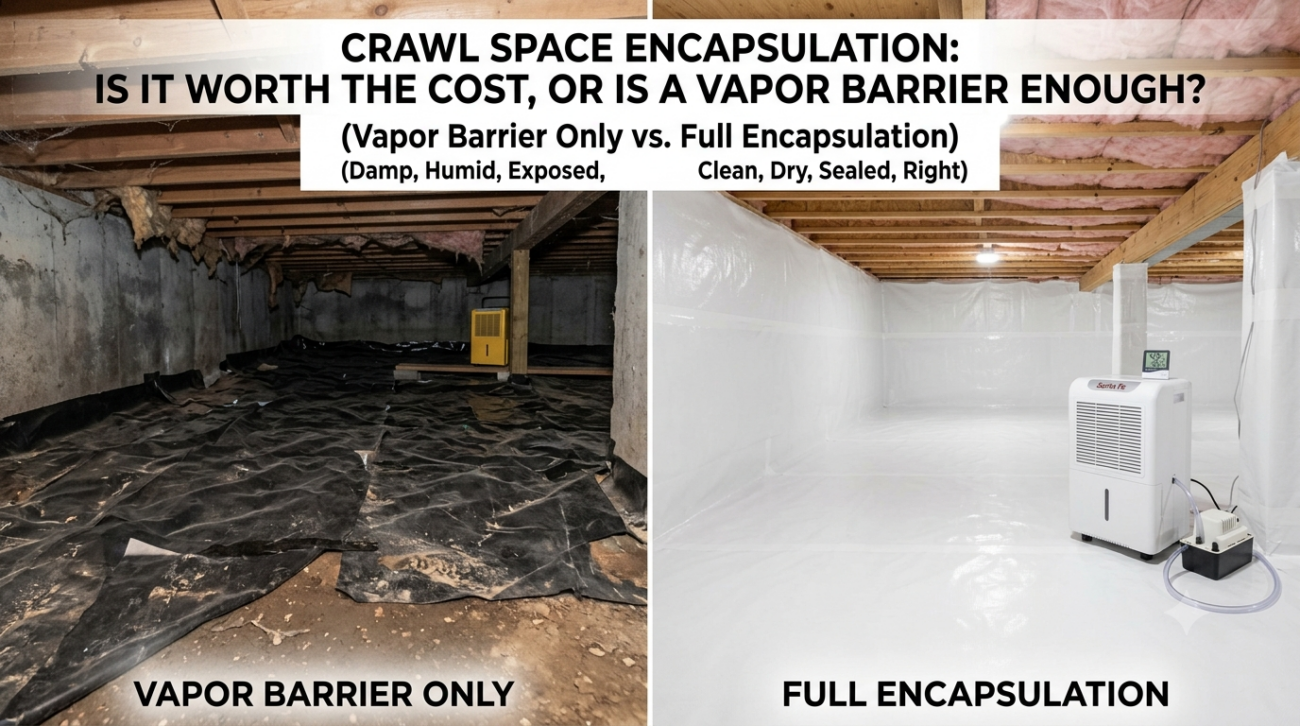
If you’ve ever crawled under your house and met damp dirt, a musty smell that follows you back up the stairs, or evidence that something with more legs than you live down there, you already know the feeling that sends homeowners searching for a fix. The question that follows almost immediately is whether you need the full encapsulation treatment a contractor is quoting at five figures, or whether a basic vapor barrier solves the actual problem for a fraction of the cost.
The honest answer depends entirely on your crawl space’s condition, your climate, and what you’re actually trying to solve. Here’s how to figure out which one you need.
What Encapsulation Actually Includes (That a Vapor Barrier Doesn’t)
These two terms get used interchangeably online, but they’re not the same scope of work. A vapor barrier is just a layer of plastic sheeting laid across the crawl space floor to block ground moisture from rising into the space.

Encapsulation is the full system: a heavy-duty 12 to 20-mil polyethylene barrier covering the entire floor and extending up the foundation walls, sealed foundation vents, wall insulation, and typically a dehumidifier to actively manage humidity according to a detailed 2026 breakdown from Palm Build Restoration.
What It Costs in 2026
| Project Type | Cost Range | What’s Included |
| Basic vapor barrier only | $1,500 – $4,000 | Plastic sheeting on the floor, minimal sealing |
| Standard encapsulation | $5,000 – $15,000 | Full barrier, sealed vents, insulation, dehumidifier |
| Complex encapsulation (mold/damage) | $20,000 – $40,000 | Full system plus remediation, drainage, repairs |
Multiple 2026 sources converge on a similar figure: Angi reports a national average around $5,500, with most homeowners spending between $5,000 and $15,000.
Per-square-foot pricing runs $3 to $10, according to HomeGuide’s 2026 data, with basic projects on the low end and severe moisture or mold situations pushing toward the top.
Where the Money Actually Goes
According to Restorable Solutions’ 2026 pricing guide, a standard project breaks down roughly as follows:
- Materials (vapor barrier, insulation, sealants): $1,500 – $3,000
- Professional labor: $2,000 – $4,000
- Dehumidifier and drainage add-ons: $500 – $1,500
Labor consistently represents 50% to 70% of total project cost across nearly every source reviewed. This is fundamentally a labor-intensive job, not a materials-driven one.
The Hidden Costs That Inflate Quotes
Before encapsulation can even begin, any pre-existing problems need to be addressed, and this is where initial estimates often balloon. According to HomeAdvisor:
- Cleaning and debris removal: $2,000 – $6,000 for a major cleanout
- Mold remediation: $1,500 – $4,000, or $15 to $30 per square foot
- Damaged beam replacement: $1,500 – $5,000
- Drainage system or sump pump (if standing water is present): $800 – $3,500
- Permits and inspections: $50 – $250
A contractor’s initial walkthrough quote can look reasonable, and then expand significantly once they’re actually under the house and find rot, standing water, or mold that wasn’t visible from the access hatch.
Is a Basic Vapor Barrier Ever Enough?
Yes, in the right conditions. A standalone vapor barrier makes sense when:
- Your crawl space is dry, with no signs of standing water, high humidity, or musty odor
- You live in a moderate, low-humidity climate where moisture accumulation isn’t a chronic problem
- There’s no existing mold, wood rot, or pest activity to address first
- Budget is the primary constraint, and you’re treating this as a preventive measure rather than a fix for an active problem
Where a vapor barrier alone falls short: it does nothing to address humidity that’s already accumulating in the air of the crawl space, doesn’t seal vents that let outside humid air in during summer, and provides no insulation value.
One 2025 industry analysis from BioSweepSE puts it directly: sealing over an existing moisture problem without addressing humidity often makes air quality worse, not better, since trapped moisture has nowhere to go.
When Full Encapsulation Is the Right Call
- You live in a humid climate (the Southeast in particular, where year-round humidity makes ground moisture a chronic issue)
- You’ve noticed visible mold, a persistent musty smell, or condensation on crawl space surfaces
- Wood framing shows signs of rot or moisture damage
- You’re experiencing higher-than-expected energy bills, which can result from an unconditioned, humid crawl space affecting your home’s overall efficiency
- You’re preparing to sell and want documented moisture protection as a selling point
Does Encapsulation Pay for Itself?
According to Palm Build’s regional analysis, encapsulation typically reduces energy bills by around 15% in humid Southeast climates and pays for itself within 5 to 10 years through those energy savings alone, before factoring in avoided mold remediation, structural repair, and pest control costs.
A separate estimate from HomeGuide puts the payback window slightly longer, at 7 to 10 years, through a combination of energy savings, reduced repair costs, and increased property value at resale.
Smart Ways to Control the Cost
- Do the prep work yourself: Clearing debris and doing a basic cleaning before the contractor arrives can meaningfully reduce labor charges.
- Address problems early: Foundation issues, moisture damage, and pest infestations all become significantly more expensive the longer they’re left untreated. Early intervention is consistently the cheaper path.
- Get multiple quotes: Pricing varies meaningfully between contractors for comparable scopes of work; compare what’s actually included, not just the bottom-line number.
- Schedule during the off-season: Spring and fall typically see lower demand and can come with better pricing than peak summer months.
- Check for rebates: Some utility companies and local energy-efficiency programs offer rebates that offset a portion of encapsulation costs, worth checking before you sign a contract.
Bottom Line
A vapor barrier is a legitimate, lower-cost option for a dry crawl space in a moderate climate where you’re being proactive rather than reactive.
Full encapsulation is the right investment when you’re dealing with an active humidity problem, visible mold, wood damage, or you live somewhere humidity is simply a fact of life for most of the year.
The mistake to avoid is paying encapsulation-adjacent prices for a contractor who skips the dehumidifier, vent sealing, or wall insulation a low-cost quote that only includes a floor liner isn’t encapsulation, regardless of what it’s called on the invoice.
