
A skylight does something no other home upgrade quite matches: it changes how a room feels throughout the entire day. Morning light tracks across a ceiling, afternoon sun shifts the mood of a hallway, and the sense of space in a previously dim room can feel like a genuine renovation rather than a single fixture change. The question that follows the idea, almost immediately, is whether that transformation justifies cutting a hole in your roof.
Here’s what skylight installation actually costs in 2026, where the price variability comes from, and how to avoid the hidden expenses that catch homeowners off guard.
Skylight Installation: Costs, Types, and Key Decisions
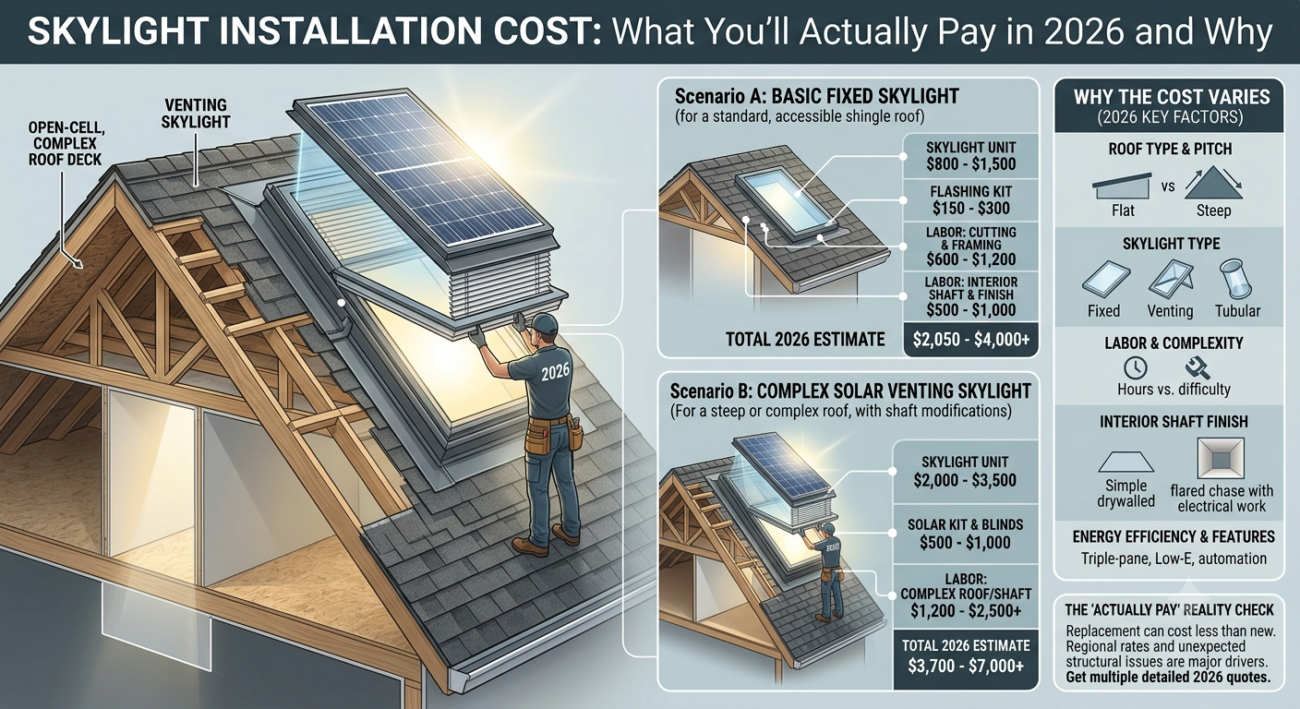
What It Costs: The Full Range
Sources converge on a wide but predictable range. According to HomeGuide’s 2026 national data, installation runs $1,600 to $4,200 on average, with the window unit alone costing $150 to $2,000 and labor adding $1,200 to $3,200 on top. Angi’s 2026 data puts the national average at $1,910 per skylight, while more complex new-opening installations on premium roofs can reach $7,000 to $8,500 according to Sunsquare’s detailed 2026 breakdown.
| Skylight Type | Unit Cost | Installed Total |
| Fixed (sealed, no ventilation) | $150 – $800 | $1,500 – $5,000 |
| Manual vented (opens by hand) | $300 – $1,200 | $3,200 – $5,900 |
| Electric / solar vented (motorized) | $600 – $2,000 | $4,250 – $7,150 |
| Solar tube / sun tunnel | $150 – $500 | $600 – $1,100 |
New Opening vs. Replacement: The Biggest Cost Variable
The single largest cost driver is whether you’re cutting a brand-new opening in the roof or replacing an existing skylight that’s already framed and flashed. According to American Quality Remodeling, a replacement in an existing opening costs $700 to $1,500 total — versus $3,000 to $5,500 for a new opening on a standard asphalt roof.
That gap exists because a new installation requires cutting through the roof deck, framing new headers and trimmers to support the opening structurally, building the interior light shaft, and finishing the ceiling around it. A replacement skips all of that structural work and is essentially a like-for-like swap.
The Hidden Costs Most Quotes Don’t Include Upfront
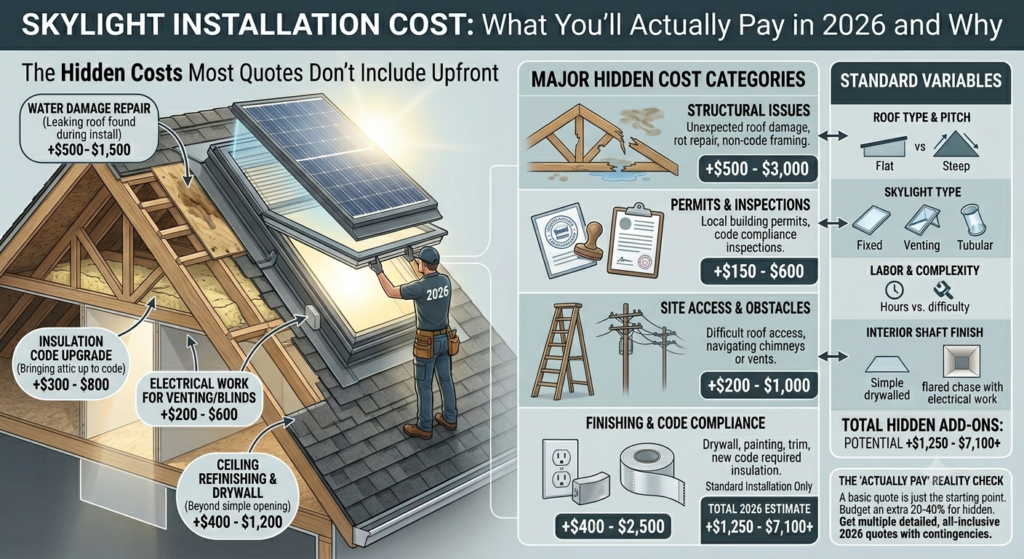
This is where initial estimates often climb. Several line items are frequently omitted from headline quotes but show up before the project is done:
- Light shaft / interior finishing: Building and finishing the tunnel between the roof and ceiling typically adds $1.50 to $3.50 per square foot of surface area — a significant addition for rooms with high ceilings or cathedral vault spaces
- Electrical work: Motorized vented skylights require wiring; adding an outlet or new circuit runs $100 to $450 in standard situations
- Permits and inspections: $50 to $500 depending on jurisdiction — most municipalities require a permit for any new roof penetration
- Structural engineer: If roof trusses need modification, an engineer costs $300 to $800 and is non-negotiable in truss-framed homes
- Interior repairs: Drywall patching, trim, and ceiling paint after installation typically runs $200 to $600
Roof Type Changes the Labor Math Significantly
Installing on a standard asphalt shingle roof is the most straightforward case. Tile or metal roofs add considerably to labor cost — cutting cleanly through these materials, waterproofing the opening, and ensuring a watertight seal is more skilled, time-intensive work. According to This Old House, roof pitch is similarly important: steep roofs require additional safety precautions and take longer, which directly shows up in the labor line.
| Roof Type | Cost Impact |
| Asphalt shingles (standard pitch) | Baseline — lowest labor cost |
| Metal roofing | +20% to +40% on labor |
| Clay or concrete tile | +25% to +45% on labor |
| Flat roof | +$500 to $1,000 for added waterproofing and curb |
Solar Tubes: The Budget-Friendly Alternative Worth Knowing
If a full skylight is out of budget or structurally impractical (truss-framed roofs severely restrict standard skylight sizing), a solar tube or sun tunnel deserves consideration. These are small-diameter reflective tubes — typically 10″ to 22″ across — that route sunlight from a roof dome down into a ceiling diffuser. Total installed cost runs just $600 to $1,100, they fit between standard 16-inch rafters without structural modification, and they deliver surprisingly effective diffuse light into bathrooms, hallways, closets, and other spaces where a full skylight isn’t practical.
How Long a Skylight Actually Lasts
Properly installed skylights last 15 to 40 years, with high-end models carrying up to 10 to 20-year warranties according to HomeGuide. The most common failure mode isn’t the glazing — it’s the flashing and seals around the unit, which can degrade in 10 to 15 years in harsh climates. When requesting quotes, confirm that the contractor’s installation includes a manufacturer-approved flashing kit rather than improvised site-built flashing — this is the single most common cause of skylight leak callbacks.
Tax Credits Worth Checking Before You Buy
Solar-powered skylights qualify for a federal tax credit of 26% to 30% under the Inflation Reduction Act, according to Bill Ragan Roofing’s 2026 analysis. For a $5,000 solar-vented skylight installation, that represents a $1,300 to $1,500 credit — a meaningful offset. Confirm eligibility with a tax professional before purchase, as credit terms can change.
Bottom Line
Budget $1,600 to $4,200 for a standard installation — more if you’re cutting a new opening on a complex roof, less if you’re replacing an existing unit. The solar tube is the smartest upgrade for tight budgets or truss roofs. And before accepting any quote, confirm it explicitly includes the light shaft finish, permit fees, and flashing kit — the three line items most commonly omitted from initial estimates that reliably appear before work is done.
